Saturday, September 8, 2012

Cobaya St. Regis with Chefs Richard Gras and Antonio Bachour

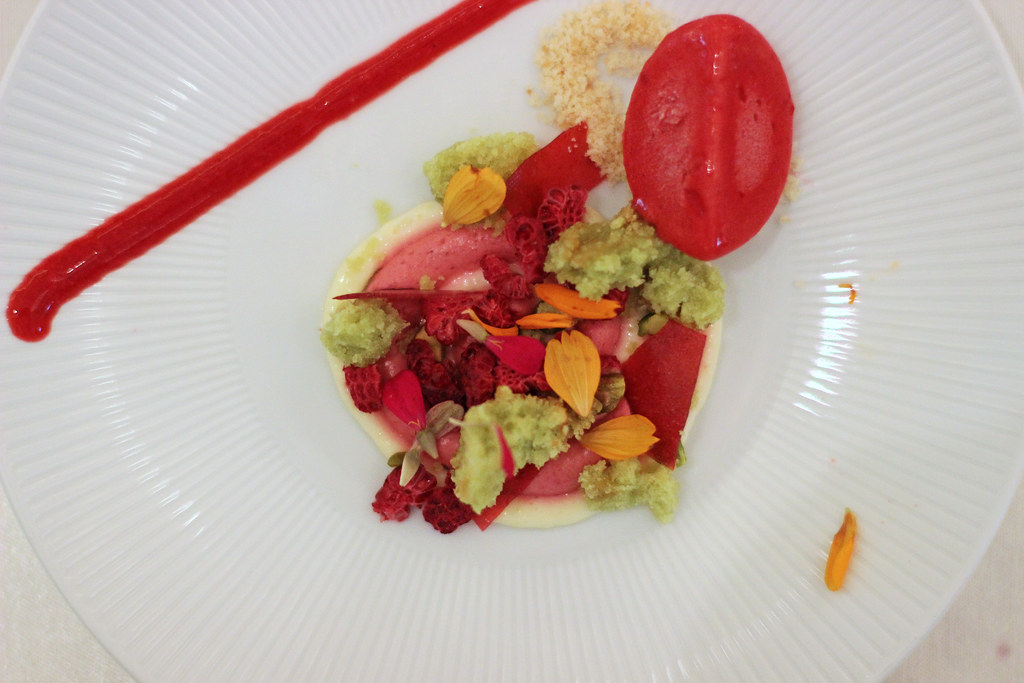
berry lemon spiral

In a recent column for the San Francisco Chronicle, restaurant consultant (and former Square One and Chez Panisse chef) Joyce Goldstein bemoans the prevalence of what many pejoratively call "tweezer food." She imagines "an underground team of tiny elves with tweezers, carefully placing tiny little pieces of food in regimented lines across plates all over the country" and rails, "Where is the passion and energy?"

It is, of course, a false dichotomy. Attention to detail and passion are not opposites, nor are they even somehow mutually exclusive. Food that is delicate, or technical, even artful, can and often is prepared with every bit as much passion and energy as any long-simmered braise or sizzling sauté.

There is no better evidence than the dinner that the crew at the J&G Grill[1] in the St. Regis Bal Harbour put together for our Cobaya "underground" dining group earlier this week. The restaurant's chef de cuisine Richard Gras, executive pastry chef Antonio Bachour, and hotel executive chef Jordi Valles[2] do elegant, careful, graceful work; I'm sure tweezers are part of their kitchen arsenal. Yet I have never met any chefs who have more passion for food, more energy, more drive to please and excite than Richard, Antonio and their team.

The St. Regis opened at the beginning of the year;[3] but while high-end travelers have been flocking in droves, I suspect many locals haven't found their way inside yet. They're missing out. Our Cobaya meal was, as we always hope they will be, an off-menu experience, so don't expect to find something exactly like this on any given Tuesday. But some tremendous talent resides in the kitchen there, and we were glad for the opportunity to showcase it.

(You can see all my pictures in this Cobaya St. Regis flickr set, or click on any picture to enlarge it).
St. Regis Bal Harbour

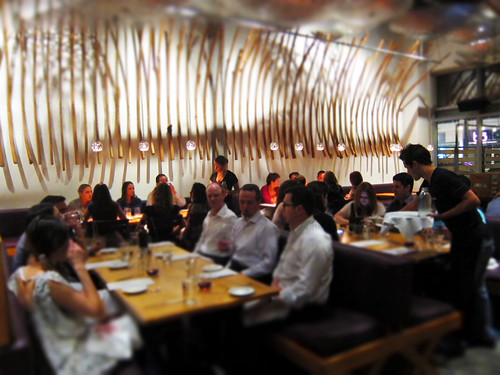
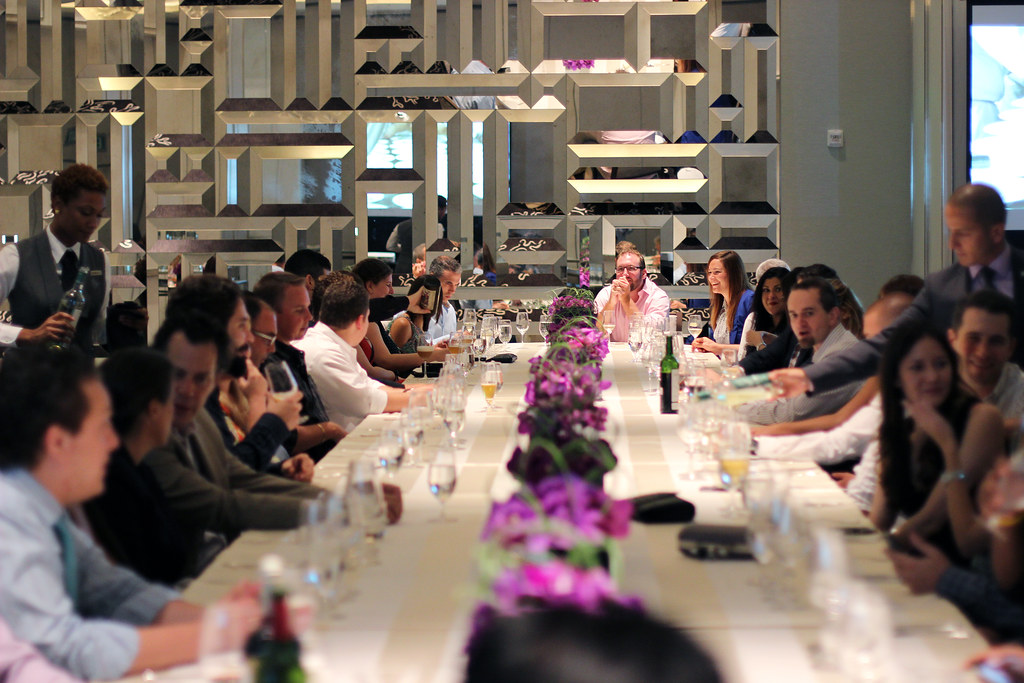
They set up our group of 34 at one long table in a space downstairs from the main restaurant; the same beveled rectangles of mirrors that line the hotel's lobby provided an elegant backdrop.
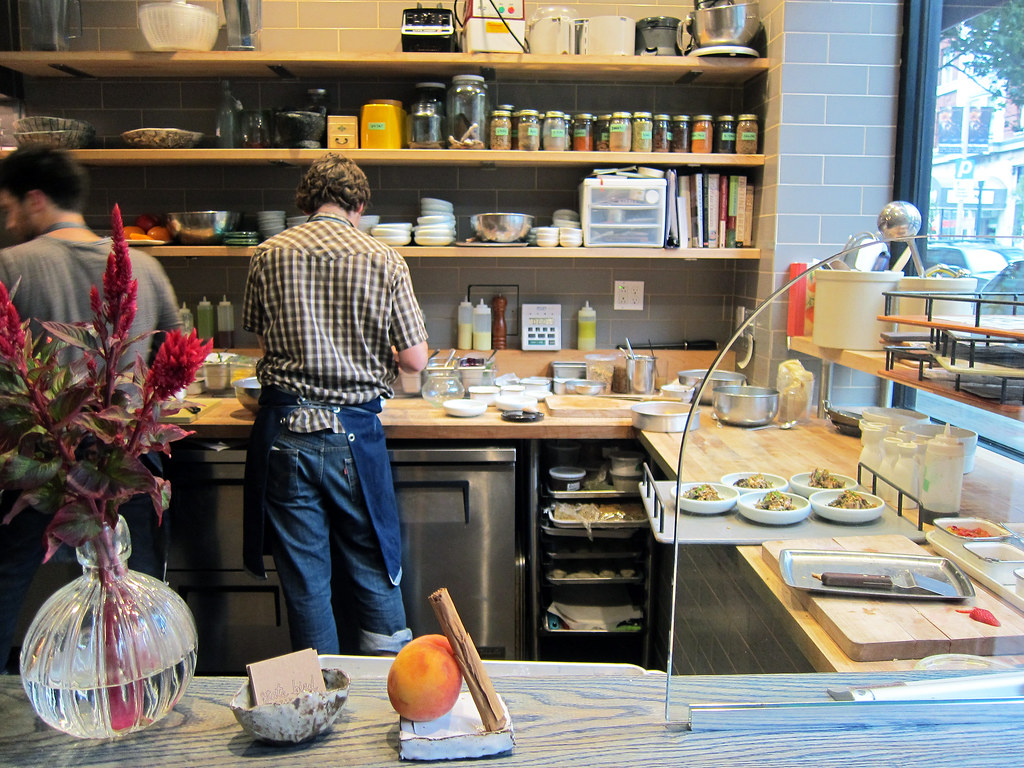
chef cam

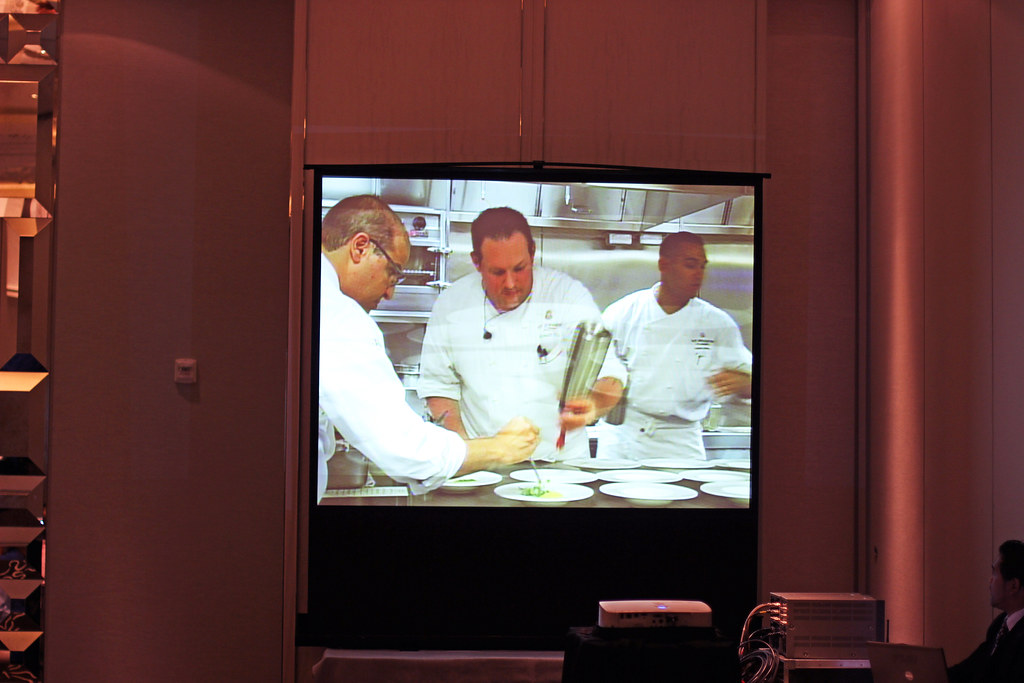
Though our table was some distance away from the kitchen, an A/V hookup, with two massive flat-screens, provided the opportunity for the guests to see and hear the chefs at work, explaining dishes as they were being prepared and plated.

beet gazpacho explosion

The dinner service started with a one-biter, a spherified beet gazpacho "explosion" served over crumbles of a lemon thyme infused pound cake - the brilliant color matched by a burst of flavor.

(continued ...)

Sunday, September 2, 2012

State Bird Provisions - San Francisco


State Bird kitchen

I keep lists of restaurants for just about any town I might conceivably visit. I don't get to do nearly as much culinary tourism as I'd like, but it's always good to be prepared. Drop me in just about any major city - several minor ones too - and in fifteen minutes I'll find a good meal.

When I get to the point of actually planning a trip, the list gets even more detailed. For a true dining mecca like San Francisco, which we've visited several times, the difficulty is not in coming up with the list but in paring it down. There are the old favorites, there are the well-known places we've still not yet gotten to, and then there are the waves of intriguing newcomers, and the challenge is figuring out what to squeeze into the limited dining opportunities.

On this particular visit, the paring down process is made both easier and harder by a couple factors. First, we've got very limited time in San Francisco, only three real dinners, in fact, as we're only in town on brief stopovers on our way to and from Hawaii. Second, this is a family trip, and I've learned from painful experience not to test their dining patience too much. I've been rationed to one tasting menu, and it's already spoken for - we've got spots at a Lazy Bear underground dinner one night, so it'll be a la carte for us the rest of the trip. That immediately eliminates a lot of the San Francisco restaurants that would otherwise be high on my list: Saison, BenuAtelier CrennSons & Daughters.

So what I'm looking for, if it makes any sense (and it does to me, anyway), is tasting menu style food, but without the tasting menu format. As I often do, I run my thoughts through Chowhound, where the Bay Area board has often steered me well. Of what's left on the list, one name keeps jumping out at me: State Bird Provisions. I'm not sure where I've heard of it, I've not read much about it, but the idea certainly intrigues: dim sum style service, pushcarts and all, but it's not Chinese food, just an eclectically assembled choice of small plates. It sounds just about perfect for our first night in town, as everyone recovers after a six hour flight.

It turns out to be exactly what I was looking for and then some.

State Bird cart

In a location adjacent to Japantown, an open kitchen hums, carts roll, and colorful little dishes pile up on the tables. But the food is geographically untethered: tofu is paired with Calabrian chiles and pesto; that doughy thing may look a bit like a char siu bao, but it's garlic bread topped with burrata cheese. And this is all no mere gimmick - eating at State Bird is fun, but the food is equally creative, thoughtful, and just flat out delicious.

(You can see all my pictures in this State Bird Provisions flickr set; click on any picture to view it larger.)

(continued ...)

Friday, August 24, 2012

(Miami) Spice of the Week


I've missed the first few weeks of Miami Spice season while on vacation, and frankly, after two weeks in Hawaii, could use some bargain dining. We go over this every year here at FFT, so here's the short-form version of my "Spice Rules":

(1) there's no reason to bother with restaurants where the Spice menu is not a meaningful discount from their regular prices (though, of course, go to them if you like them; just don't do so because they're offering a Miami Spice menu);

(2) the infamous chicken breast / farmed salmon / churrasco (or substitute short rib) "trifecta" is usually a tell that a restaurant doesn't have its heart in it; and

(3) look for food that actually interests you. If a restaurant doesn't excite you the other ten months of the year, it is unlikely there's going to be something really inspiring on their Spice menu.

The Miami Spice format is a bit different this year. There are now two categories: "Luxury Dining" and "Fine Dining," with different price points: $23 lunch / $39 dinner for "Luxury Dining," and $19 lunch / $33 dinner for "Fine Dining." And if you can remember which is which five minutes from now, you're smarter than me.[1]

I decided to do something a little different myself this year as well. I set out to see if I could come up with a "Week of Spice" - a Spice lunch and dinner for each day of the week that satisfied my "Spice Rules." Then for the real bargain hunters, I've added for each day an alternate dinner choice in the lower-priced "Fine Dining" category.[2]

Not that I would actually do this: I sure don't need to eat two desserts every day, nor do I really need to spend $60+ on restaurant meals every day. But it was a good exercise in picking what look like the seven best lunch and dinner menus being offered, including on Fridays and Saturdays (when some places have elected not to offer their Spice menus).

This is not a complete listing of each restaurant's menu (and menus change regularly anyway), just my personal picks of what sounds best. These are not listed in order of preference, and indeed some of the best are saved for the end, so I'd encourage you to wade your way all the way through.

(For an alternative take on this year's Spice menus, don't miss Miami Rankings' "2012 Miami Spice Awards")

(continued ...)

Wednesday, August 22, 2012

A Key West Weekend


Maybe it's the three hour drive that sloughs away petty worries and aggravations, as south Miami suburbia gives way to Homestead farms and nurseries, which in turn give way to islands and open water. Maybe it's the people, the motley historical confluence of traders, fishermen, treasure seekers, drug dealers, Cubans, Bahamians, gays, hippies, writers, musicians and miscreants of all sorts that make it feel so different.  Maybe it's just that feeling of being completely enveloped by ocean, the Atlantic on one side and the Gulf of Mexico only fifteen blocks away on the other. Even for a native Miamian like myself, Key West really feels like something of an escape.

Key West is an easy trip from Miami; still, it's also one I find strangely easy to overlook in favor of other more exotic, more distant destinations. But with nearly 5,000 miles of air travel coming up (we headed down there the weekend before taking off for Hawaii for two weeks) and a couple days free, it was the perfect getaway for a couple days of rest and relaxation. Here are a few brief snapshots from our Key West weekend.

(You can see all the pictures in this Key West flickr set.)


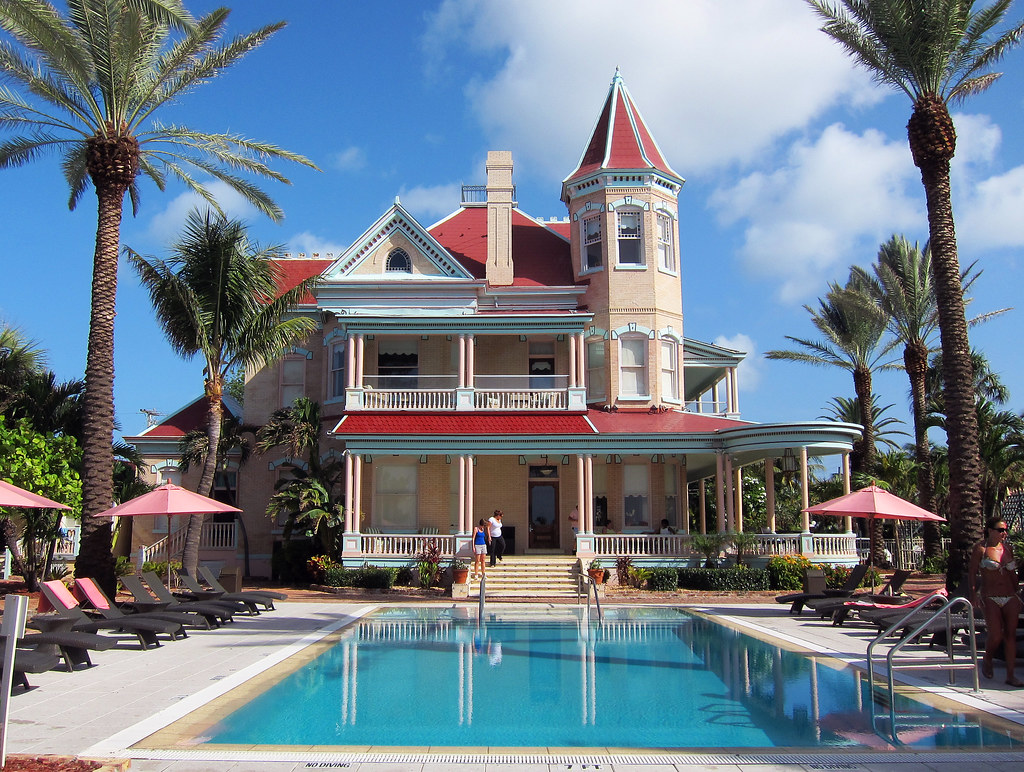
Home base was the Southernmost House, a late 19th century Queen Anne Victorian literally on the very southern tip of Duval Street. The property has a great history: Thomas Edison designed the electrical system,  it served as a speakeasy during Prohibition, and its visitors in later years, when it was the "Café Cayo Hueso," included the usual cast of Key West characters: Ernest Hemingway, Tennessee Williams, Gore Vidal, Truman Capote.


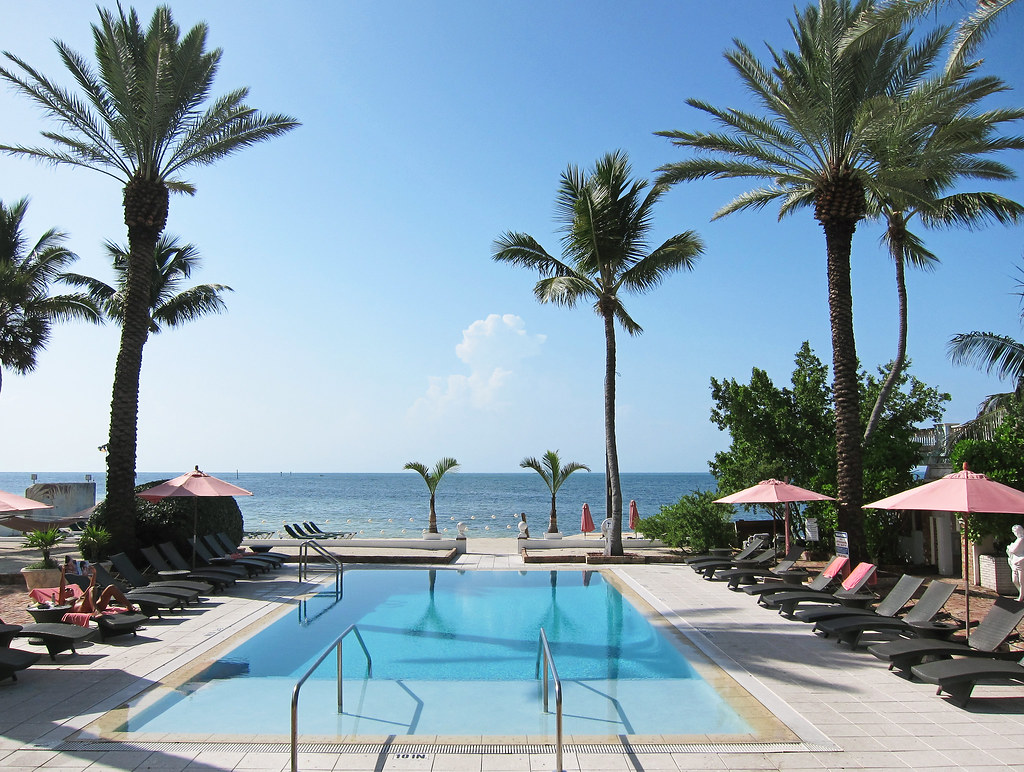
Today it has comfortable, updated rooms and a pool that practically spills right into the ocean. It's also on the quieter, more remote end of Duval Street, away from the hubbub of the center of town and the yahoos who sometimes populate it.


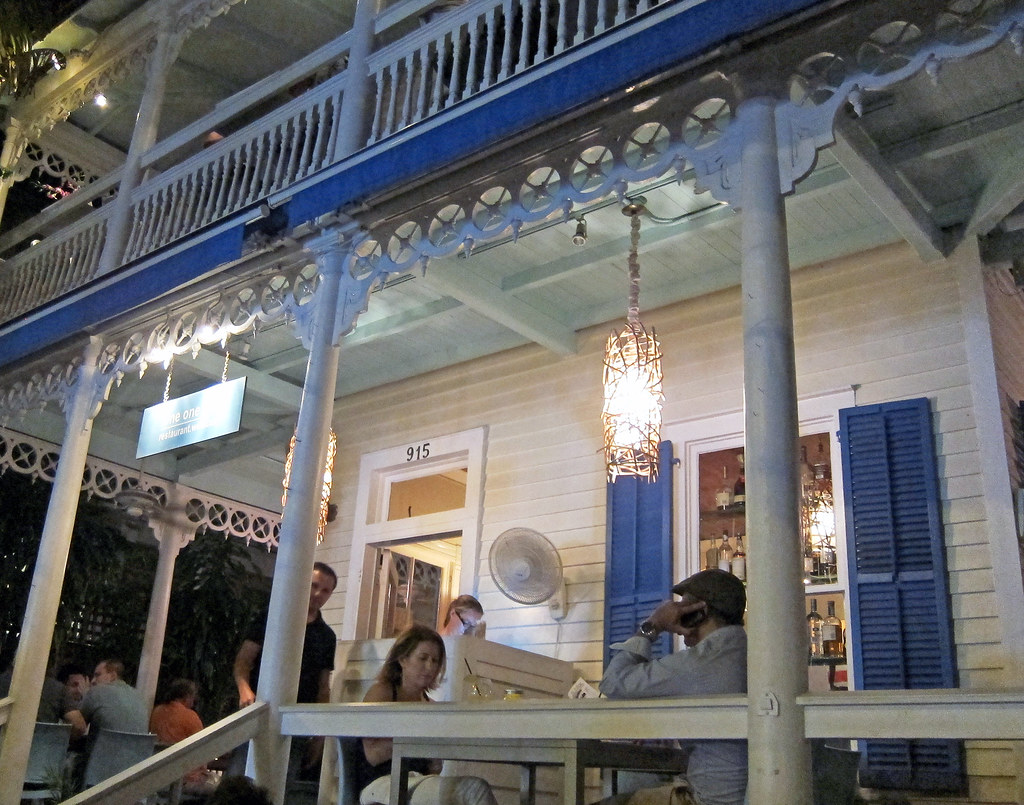
Our late arrival Friday evening had us hunting for dinner somewhere close by, which brought us to nine one five. This is a restaurant that was oft-recommended, and while it looks much like many other places in Key West with its Victorian trim and wrap-around porch, it was somewhat more ambitious than your average coconut-shrimp intensive tourist trap. (Note: a conspiracy of bad lighting and dead camera battery meant pretty much no food pictures for the weekend). Appetizers outnumbered entrées on the menu by nearly two to one, and our order was similarly inclined, sharing a few starters and one main course between the two of us.

(continued ...)

Monday, August 20, 2012

Summer Reading List

beach

Well, I forgot to hang the "On Vacation" sign out before leaving, but indeed I've been gone - in Hawaii for most of two weeks, with too-brief stopovers in San Francisco on the way to and from. Some reports from the islands - Maui and Big Island in particular - will follow. We also ate incredibly well in our few days in San Francisco, starting with State Bird Provisions (named Bon Appétit's "Best New Restaurant of the Year" a few days after our visit), AQ, and finishing our trip with a Lazy Bear underground dinner. Lots of pictures are already up on flickr if you're interested in a preview.

To phase back in gently, here is the tried and true crutch of those lacking the energy to write their own material: the "What We're Reading" list. It just so happens that there were a number of interesting things I read over the past couple weeks which seemed worth sharing (and, it's easier than writing my own right now):

Top 50 Best New Restaurants (Bon Appétit) - by most accounts (and from my experience at State Bird and AQ, anyway) a very solid list.

Vacation (Michael Laiskonis' Notes from the Kitchen) - the mightily talented Laiskonis has been doing a lot of writing lately, and this description of a "perfect" meal is a great example with an apropos title.

What Danny Meyer's Customer Tracking System Really Says About You (Grubstreet New York) - an expansion of a fun New York Times piece on restaurant code (my favorite: "s'ammazzano," or "killing themselves," for a diner planning to propose), explaining how Meyer's Union Square Hospitality Group keeps dibs on good - and bad - customers.

Repetition Defines Us (Michael Hung, Inside Scoop SF) - a simple essay on the nature of being a cook that seems to have particularly resonated with those in the business.

Would YOU Want to Have the New York Times Restaurant Critic Over For Dinner? (Adam Sachs, Bon Appétit) - a funny piece about a food writer cooking for present and former New York Times critics Pete Wells and Frank Bruni.

Should a Wine List Educate or Merely Flatter You? (Eric Asimov, New York Times) - a smart retort to a Steve Cuozzo column complaining about wine lists that go over his head, advocating the virtues of the unfamiliar and esoteric.

And for some longer reads:

The Raw and the Cooked (Jim Harrison) - I'm not sure why it took me so long to get around to reading Harrison; I'm glad I finally did so. He's a gutsy, passionate writer with a gargantuan appetite for food and life, and a real pleasure to read.

Kafka on the Shore (Haruki Murakami) - not a food book (though Murakami habitually notes what his characters eat for each meal), just a magnificent, surreal, transporting kind of novel that was the perfect reading material for several long flights.


Monday, July 30, 2012

Goes Around ... Comes Around - Etxebarri Edition

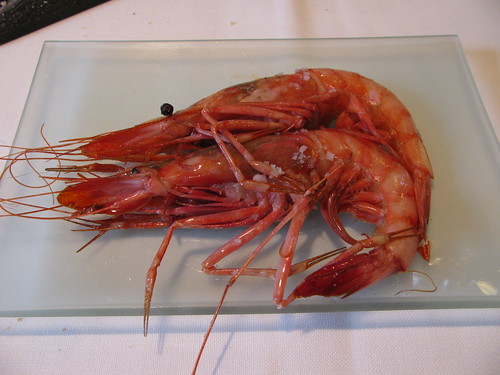
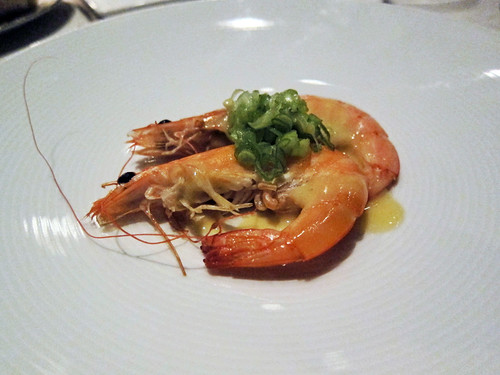
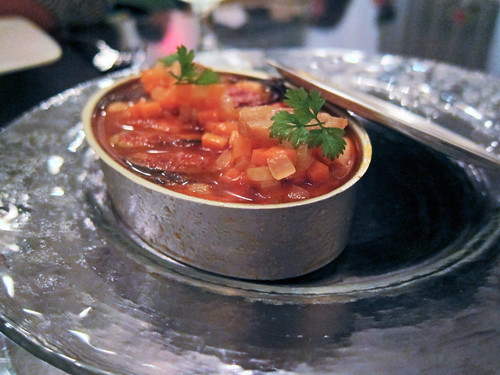
Clearly I'm not the only fan here in Miami of Asador Etxebarri, the wonderful temple of grilling in Spain's Basque Country that I visited a couple years ago:


Gambas de Palamos, Asador Etxebarri, Axpe, Spain, September 2010


Florida Soft Shell Shrimp, Tuyo, Miami, Florida, July 2012


Mejillones a la Brasa, Asador Etxebarri, Axpe Spain, September 2010


Mediterranean Mussels, The Bazaar, Miami, Florida, July 2012


Tuesday, July 24, 2012

The Bazaar for Dummies


So let's say you want to eat at Bazaar South Beach, but you don't have the patience to wade through 4,000 words and 19 footnotes to figure out what to order. Here's my version of "The Bazaar for Dummies" - a simplified (and opinionated) guide to the 60+ item menu. For more details, consult the long-playing version.

Must Have:[1]

Papas a la Huancaina - Peruvian potatoes, sea urchin
Baby Japanese Peaches - fresh burrata, hazelnuts, arugula
Black Rossejat - paella-style pasta, squid ink, shrimp, aioli

Really, Really Good:

Kueh Pai Ti - Singapore's favorite street food - shrimp, peanuts, chili sauce
"Colada Cubana" Yogurt - coffee with foie gras
Almond Yogurt - tomato granite, fresh almonds
Smoked Oysters - ice and smoke, apple mignonette
Jamon de Toro - salt-cured fatty tuna like Spanish jamón with picas
Yuca "Churros" - with peanut butter and honey
Ajo Blanco - mango, sherry ravioli, king crab, fresh almonds
Butifarra Flauta - piquillo peppers, aioli, piparra
Frozen Blue Cheese Sandwich - lemon marmalade, walnut bread
Mediterranean Mussels - olive oil, sherry vinegar, pimentón
Sautéed Catalan Spinach - apples, pine nuts, raisins
Pa amb Tomaquet - Catalan-style toasted bread, tomato
Patatas Bravas - fried potatoes, spicy tomato sauce, aioli
Escalivada with Blue Cheese - Asturias meets Catalonia, José's two loves!
Sea Urchin - butter, black pepper, toasted bread
José's Taco - caviar, jamón Ibérico
Banana Mojito - mojito sorbet, mint and caramelized bananas
Key Lime Pie - José's way

(continued ...)

Monday, July 23, 2012

The Bazaar - South Beach


If it wasn't the most eagerly anticipated restaurant opening in Miami, The Bazaar was certainly the most long-awaited. Speculation that Chef José Andrés might be opening a Bazaar in Miami started all the way back in early 2009, shortly after the original Bazaar Los Angeles opened, when the SLS hotel chain started work on the Ritz Plaza hotel on South Beach.[1] The patter continued in 2010. And then we waited. And waited. And waited, as is the customary Miami style.

Finally last month, Bazaar South Beach opened. It was worth the wait.[2]

I've not been to The Bazaar in L.A., but I've been to several other of Chef Andrés' establishments - Washington DC's Jaleo several times, minibar back in 2008, the now-closed Café Atlantico, plus more recent visits to é and China Poblano in Las Vegas. (For more background on Chef Andrés, read my post on é.) The Bazaar borrows bits and pieces from each of them. There are traditional Spanish tapas, many of which are mainstays on the Jaleo menu. There are more contemporary dishes, often derived from items that started as part of the minibar and é multi-course extravaganzas. And there's even a section of the menu described as "Miami Meets the World," an unusual conglomeration of Singapore street foods, ceviches and "nigiri," and several more items with Latin American flavors, similar to the Asian / Mexican mash-up he does at China Poblano.[3] It is a sprawling, ambitious menu - perhaps even more so than the original Bazaar in L.A.

The venue itself is not quite as grand as I might have anticipated, though it's growing on me. The Ritz Plaza is one of Miami Beach's old Art Deco hotels, built in 1939, and like many of the Art Deco properties, it doesn't really have a separate space set aside for a restaurant. What this means is that as soon as you pass through the hotel doors, you've stumbled into the "Rojo" room, the first of two dining rooms of The Bazaar, with the hotel's check-in desk off to the other side of the entrance.

(You can see all my pictures in this Bazaar - South Beach flickr set).


Done up in traditionally Spanish red and black colors but with a contemporary feel, this is the more casual of the dining rooms. Two- and four-tops line the near wall, while larger tables, some bar-height, occupy the middle of the room, flanked on the far wall by a bar and open kitchen.[4] A taxidermied bull's head wearing a lucha libre mask, by artist Mikel Urmeneta,[5] looks out from one wall, while above the bar is a mural by local artist Claudio Picasso that hearkens back to the hotel's original Art Deco style.


On the other side of the bar and kitchen is the "Blanca" dining room, simultaneously a little more posh and a little more cozy. Much of the seating is on well-cushioned sofas; knick-knacks and antique photos adorn ledges on the walls; a massive shell-encrusted chandelier hangs from the ceiling. It looks like it could be your abuela's living room, if your abuela hired Phillippe Starck as a decorator.[6]


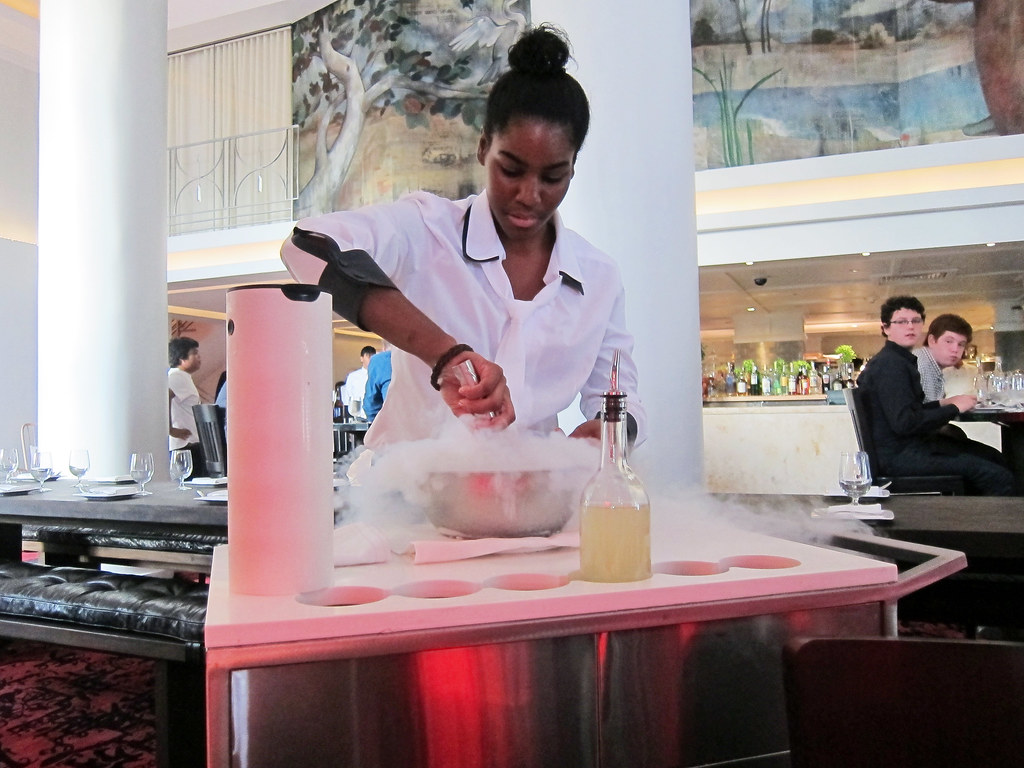
A good way to start a meal is with a LN2 frozen caipirinha, a fun bit of tableside cryotechnics by which the traditional Brazilian concoction of cachaca, lime and sugar is mixed with super-cold liquid nitrogen in a dramatic billow of steam to a perfect slushy consistency.


At $5 each, it's also the "Joe's Fried Chicken"[7] of the Bazaar menu, even if the portion size has been tapered back a bit since my first round.


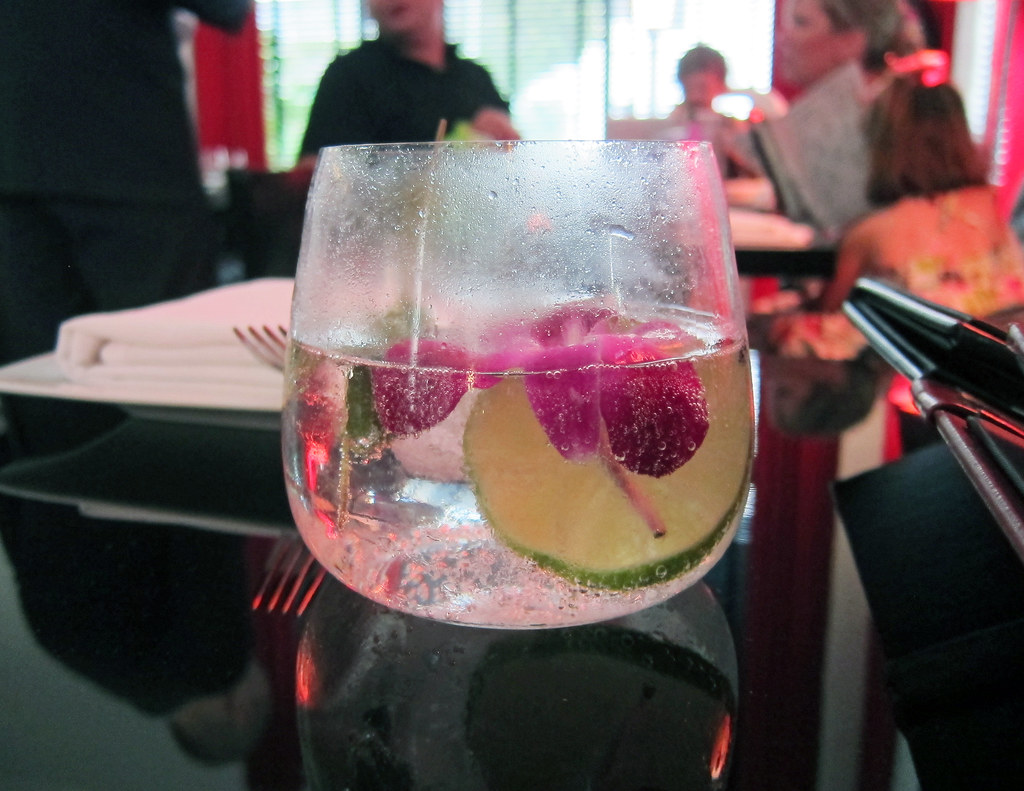
You could alternatively start with "The Ultimate Gin & Tonic," which at $18 is no bargain at all, but is still a very fine drink. Spaniards are obsessed with the "gintonic," and this version plays up that obsession by reintroducing the botanicals typically used in the spirit: Fever Tree tonic, juniper berries, fresh herbs and flowers, and lime mingle in the glass along with your choice of gins.[8]

This will also give you some extra time to peruse the menu, which you're going to need. With over sixty items - even more if you count the selections of Spanish hams and cheeses - it's a fairly daunting prospect, even for an avid menu decoder like myself.[9] Almost exclusively tapas-style small plates, the choices divide into two main themes - "Miami Meets the World" and "Spain Yesterday and Today" - which each get further broken down into several subdivisions. The "Miami" section includes a "Singapore Connection," "Yogurts and Cones," "New Generation Nigiri and Ceviche," "Seafood," "Fruits and Vegetables," "Meats," and "Some Little Sandwiches." "Spain" includes "Latas y Conservas," "Jamones y Embutidos," "Quesos," "Verduras Tradicional," "Pescado y Marisco," and "Carnes."

Ready? Let's dive in.

(continued ...)

Monday, July 16, 2012

State of the Union (of Miami Dining)

I'd been a bit despondent of late over the closing of a couple of my more favorite Miami restaurants. It is, of course, a known fact that the restaurant business is a brutally difficult one. Restaurants - even successful ones - don't live forever, and relatively few have the staying power to last more than a few years.[1] But that still doesn't keep me from becoming attached, especially to places that do things right.


Sustain, in Midtown Miami, was one of those places for me. It wasn't the best restaurant in Miami; it wasn't even the best of the farm-to-table, sustainable-sourcing themed restaurants in Miami (Michael's Genuine remains the category-killer of that genre).[2] But it was a good restaurant. The menu balanced the accessible (fried chicken, burger, pizza, all done quite well) with the exotic (roasted marrow bones with pineapple jam, turnip "carpaccio"). The execution was solid and improved with just about every visit. The staff was friendly and knowledgeable, the cocktails were outstanding, the wine list assembled by Daniel Toral offered some of the best sub-$50 selections in town, the music was great. The Sunday brunch they rolled out shortly before closing was becoming a regular ritual for us. It was the kind of place I could go to the bar and grab a snack, or bring a group of family and friends, and everyone would leave happy. And yet Sustain was - well, unsustainable.[3]


Michelle Bernstein's Sra. Martinez in the Design District was another place that kind of broke my heart a little when I heard it was closing. We were at Sra. Martinez the night after it opened in December 2008 for Mrs. F's birthday, and we were there again the night before it closed earlier this month. Both were outstanding meals, and we had many more in between. There is a long list of dishes from Sra. M that I will pine for if they don't resurface somewhere else: the crispy artichokes with lemon aioli, the eggplant drizzled with honey, the duck and foie gras butifarra sausage with gigante beans, the marrow bones with eel and apples, the egg yolk "carpaccio." But Chef Bernstein has always understood the magpie-like nature of the Miami dining market, the constant attraction to the latest shiny object, and I don't see the Sra. M closing - after a 3 1/2 year run - as a failure so much as a step towards yet another reinvention. Still, I will miss it.

Since I started writing this blog 3 1/2 years ago, I've been feeling increasingly positive about Miami's dining "scene." Though still prone to either chasing the latest trend (food trucks, Momofukian Asian mash-ups) or sticking with the tried and true (steakhouse, generic Italian), the restaurant population these days overall is much more diverse, much more open to creativity, than when I started keeping track.[4] Yet I was still led to wonder: were these closures just the usual market forces at work, or the sign of something bigger? So my co-conspirators in the Cobaya underground dining group, Chowfather, Steve BM, and I gassed up the Cobaya Bus and took it out for a spin to assess the state of Miami dining.[5]


(continued ...)
Sunday, July 1, 2012

I don't care if Monday's blue ...


Miami is not exactly at its most charming in the summmer: the constant 90°+ heat and sweltering humidity can wear just about anyone down. But for those of us who stick it out year round here, there are at least a few good things about summer. There's mango season, for one. And there are the dining specials, designed to bring the locals out from their air-conditioned caves until the tourists come back in the fall.

We're still a month away from Miami Spice season, but there are already enough restaurant specials to fill out nearly the full week of dining. Consider:

Monday - It's not quite every week, but Sugarcane Raw Bar Grill has been using Monday nights to host a "Dinner with Friends" series of guest chef events. Chef Timon Balloo has already teamed up with Jamie DeRosa (Tudor House), Paula DaSilva (1500°), Lee Schrager (SoBeWFF), David Bracha (River Oyster Bar), Dean Max (3030 Ocean), and Dena Marino (MC Kitchen). Coming up next: Cesar Zapata (The Federal) on Monday July 23, and Clay Conley (Buccan) on Monday August 27. Reservations open up on the 10th of each month, priced at $110 including beverage pairings. For more info, email Sugarcane.

Sugarcane Raw Bar Grill
3252 N.E. 1st Ave., Miami
786.369.0353

Tuesday - Every Tuesday through the summer, it's "Bourbon, Beer and Q" night at The Dutch. Each week they will be featuring a different genre of BBQ, with a spread of several mains and sides for a fixed price of $30 (excl. tax, tip and beverages), plus $3 PBR tallboys and $22 pitchers of cocktails. This coming Tuesday, July 3, is Memphis-style, with dry-rubbed baby-back ribs, whole roasted and smoked BBQ turkey breast, and BBQ spaghetti with pork shoulder,[1] plus fried pickles, corn on the cob, and brown sugar sweet potatoes. Every week will bring a different style, with St. Louis, Carolinas, and Korean in the pipeline.

The Dutch
2201 Collins Avenue, Miami Beach
305.938.3111

(continued ...)

Tuesday, June 26, 2012

Cobaya "Dunch" with Chef Micah Edelstein


Many people probably think it's just a gimmick that we refer to our Cobaya events as "experiments." But we really do push chefs to push themselves. This is not simply an excuse to trot out the same old dishes in a fixed price, tasting menu format. If there's one "rule," it's that it has to be an off-menu experience.

What diners may not fully appreciate is that oftentimes, this means they're getting a dish that the chef not only has never served before - sometimes they've never even made it before. And since we're rarely working with chefs who have the opportunity or budget to do a full dry run in advance, often these really are experiments of a sort, and the diners really are the guinea pigs.

That was undoubtedly the case with our most recent Cobaya event, a late brunch ("Dunch") with Chef Micah Edelstein of neMesis Urban Bistro in downtown Miami. Which, to me, makes the meal she put together all the more remarkable.

(You can see all my pictures in this Cobaya "Dunch" at neMesis flickr set)


We wanted to do it on Sunday, when we could take over neMesis' cozy dining room, and that quickly turned to thoughts of brunch. Brunch became "Dunch" (dinner / lunch) when we proposed a noon-ish start time, to which Micah responded "I don't get up before noon on Sunday!" Though we didn't start until 3pm, I suspect she had to rise a little earlier than usual anyway.


The menus on the tables were actually the final iteration of sketches Chef Edelstein prepared both to brainstorm dishes and game-plan their preparation, an interesting insight into both the creative and logistical processes of putting together the meal. Afterwards, she shared with me some earlier versions, which showed how some dishes changed and evolved, and also how each of the components was highlighted or crossed off as it was prepared. I'll show each course here with both the sketch and the final realization.

(continued ...)

Saturday, June 23, 2012

Goes Around ... Comes Around: Spanish Edition

We periodically devote our attention here to the task of tracing how food ideas and trends migrate their way from restaurant to restaurant. As we noted way back when,[1] sometimes the phenomenon is the result of "homage" or "inspiration;" sometimes it's "copying" or "plagiarizing," the lines between which are not always easily drawn. Every once in a while it may actually be a case of genuinely spontaneous independent creation.

Often, what prompts these reveries is the audacity of a chef who claims to have "invented" a dish. Almost invariably, such braggadocio is unwarranted. There is, in fact, very little that is truly new under the sun, and very few culinary creations can legitimately claim to be so completely untethered to what came before as to constitute an "invention."

That apparently doesn't stop Chef Alex Raij: ["Alex Raij on Copycats and Surviving in New York."]

I'll bet I'd really like Chef Alex Raij's food. For several years now, she's put together menus of pretty authentically Spanish tapas dishes for New York restaurants, first at Tia Pol, then El Quinto Pino, then plumbed more deeply the depths of Basque cookery with Txikito, and most recently opened La Vara, which explores the even more esoteric Moorish-Jewish-Spanish food connection. I love all that stuff, and by most accounts, she does it very well.

So why the compulsion to shit-talk other chefs? In the recent Eater piece, Chef Raij simultaneously (1) claims "first" for several dishes; and (2) complains that several other chefs (specifically, Ken Oringer of Boston's Toro, coming soon to NY, and Miami's Michelle Bernstein) have "stolen" dishes, either from her or others. Specifically:

You say that before you opened Tia Pol, no one was doing certain things that are now common.
No one was doing a current expression of tapas. I wanted to dispense with all the Spanish dishes that were on every menu. No one was doing patatas bravas or shishito peppers. Nobody was making bikini sandwiches or pintxos morunos. No one was eating romesco sauce. I'm resentful, in some ways, but not regretful.
...
What bothers me is when people get called innovative when they've taken someone else's idea. Toro is coming to New York, but he straight-up took the uni panini from us. I know he took it, and he knows he took it. It's one of the few original things I've created in my life.
...
Michelle Bernstein took that Bar Mut dish and then got called a creative genius by Frank Bruni.
...
What bothers me is when people don't credit where they took it from. When we borrow something, we give credit and name the restaurants we love in the menu.
Let's take each of those in turn.


(continued ...)

Monday, June 18, 2012

Animal Pizzeria

chefs at work

Not long after Chef Michael Schwartz opened up Harry's Pizzeria, he started putting the space to use for more than just baking pies. In a twist on the "pop-up" genre that is the restaurant industry's latest trend, Schwartz has brought in chefs from around the country to cook for an evening in his little pizza parlor. In November 2011 Harry's held its first pop-up dinner with Gabrielle Hamilton of New York's Prune. Since then, Harry's has played host to a distinguished list of visiting talent: Jonathan Waxman, Marc Vetri, Jonathon Sawyer, and Kevin Sbraga. Last night, it was chefs Vinny Dotolo and Jon Shook, of Los Angeles' Animal and Son of a Gun, who took over the restaurant for the night.

Some folks may know Shook and Dotolo from their successful L.A. restaurants. Some may remember back to their short-lived stint on the Food Network with "Two Dudes Catering." Though I didn't know it at the time, I've actually been eating their food since even before then - they both cut their teeth at the Strand here in Miami Beach (now long gone) more than a decade ago, back when a young Michelle Bernstein was the chef and I was taking Mrs. F there for date nights.

Though Dotolo and Shook had not crossed paths with Michael Schwartz back in the day, they'd become acquainted more recently on the charity circuit, and - lucky for us here in Miami - came back home to put together a dinner at Harry's.

(You can see all my pictures in this Animal Pizzeria flickr set).

kumamoto oysters

Some passed appetizers started things off, including these kumamoto oysters. A cucumber and serrano chile gelee provided a great balance of cool and heat to set off the briny pop of the oysters. Crostini topped with sautéed porcini mushrooms and a rich truffle fondue offered a more earthy starting point for the meal.

triggerfish crudo

Though I enjoy it, often fish crudo seems like a "throwaway" of a dish - fish, oil, salt, citrus, done. Too easy. So this was actually a pleasant surprise: mild, faintly sweet slices of triggerfish swam in a colatura vinaigrette with that unique umami zap fish sauce provides of intense flavor without heaviness. Fresh basil and mint, chopped peanuts, and crispy fried shallots pulled things further in a Thai direction, with a little something different in each bite.[1] I might have worried that the fermented fish funk of the colatura would be a bad pairing with the fresh raw fish, but I loved the combination.

(continued ...)

Saturday, June 2, 2012

Cobaya Carmellini (a/k/a Cobaya Goes Dutch)

We've actually been in talks for this Cobaya dinner since last October, before Chef Andrew Carmellini opened his Miami outpost of The Dutch. Of course, Carmellini has had some other stuff on his plate - opening the Miami restaurant, running Locanda Verde and The Dutch in New York, publishing a new cookbook, "American Flavor," to name a few. But the stars finally aligned last week, when Carmellini and his Miami crew, including Chef de Cuisine Conor Hanlon and Pastry Chef Joshua Gripper, put together a fantastic-looking menu for thirty guinea pigs.

I say fantastic "looking" because, sadly, I had to miss this one due to work-related travel. But I did stop by before the dinner and Chef Carmellini was gracious enough to give me a tour of the kitchen to see what was in progress. The theme carrying through several of these dishes was "The Whole Damn Thing!" - turbot cooked whole (innards and all, if he stuck with the plan as of around 4pm the afternoon of the dinner), with a sauce made from the bones; a fifty pound pig from Hialeah, prepared about a half-dozen ways. And though I didn't get to taste any of it, I got a good look at what I missed out on from the folks who were there.

It's the first Cobaya dinner I've missed, and it sure looks like a great one. It's also my first time trying to recap a meal I didn't eat.

Here's Chef Carmellini providing a greeting to the diners, the menu, and below, pictures from some of the folks who were at the dinner. (Video courtesy of Ethan Shapiro, pictures via Chowfather, Allison Riley a/k/a Y'All Taste This, and Andrew Carmellini). My usual descriptive flourishes will be missing - wish I could tell you about it..


Lemon Arrancini, Caviar, Creme Fraiche
Watermelon, Cobia, Spicy Yuzu
Bulgogi Tartare, Jae's Kimchi, Lettuce
Duck Foie Gras Meatball, Celery, Cherry Mustard

Bluepoint Oyster, Cucumber Shiso Granite
Lake Meadow Egg, Smoked Sable, Trout Roe
Gnocchi di Patate Primavera con Funghi e Piselli
Turbot Cuit Entier Sur L'Os Aux Saveurs Marocaine
Whole Hog Cooked in a Variety of Ways with Condiments

Crispy Testa with Gribiche
Smoked Ribs Glazed in Cider
Pastrami-Brined Belly
Alsatian-Style Shoulder with Mustard
Brown Sugar-Cured Hams
Crispy Pig Ears, Swank Farms Arugula, Meyer Lemon
Natural Jus

Conor's Pickle Pots
Pickled Bread & Butter, Michael Borek's Farm Field Tomatoes
Pickled Ramp Relish
Grilled Georgia Peaches
Mom's Collards
Weinkraut MSG Style
Mustards

Rainier Cherry Consommé, Manhattan Granita

Croque en Bouche Royal

Ice Creams, Sorbets, Sauces, Cookies, Candies, Chocolates

(continued ...)

Wednesday, May 30, 2012

The Frod Burger at Blue Collar

The month of May, according to authoritative source "A Hamburger Today," is "National Burger Month." To celebrate the auspicious occasion, Blue Collar Restaurant has been running burger specials every week inspired by local food writers, including - yes - yours truly. I'll admit: it is difficult to resist the allure of having a menu item named after you.

Blue Collar, by way of quick background, is a casual comfort food kind of place run by Chef Daniel Serfer, a Chef Allen alum. Opened around the beginning of the year, it's tucked into the small nook in the Biscayne Inn that used to house the now-defunct American Noodle Bar. I've not written about it yet but have been in several times.

Blue Collar's burger creations thus far have included the Chowfather Burger, topped with their "Big Ragout," latkes, bacon and a fried egg, the Fat Girl Hedonist Burger with chorizo, fried shallots, smoked gouda and chipotle mayo, and the Food-E Burger (a/k/a the Breakfast Burger), with Canadian bacon, an egg, maple mustard, and a side of cheese grits.

Now, behold the Frod Burger:

Frod Burger

My particular version was loosely inspired by the outstanding burger served at Le Pigeon in Portland, Oregon.[1] It includes slow-cooked, golden, caramelized onions, sharp cheddar cheese, an iceberg lettuce "slaw," and a smear of a a ruddy piquillo pepper aioli for good measure.

All of Blue Collar's burgers use a patty fashioned from prime dry-aged NY strip, a pretty luxurious grind for a pretty casual place. They also now all come housed in a "Portugese muffin," which may be a close to perfect vehicle for a burger. It's like the love child of an English muffin and brioche, tender but still having enough heft to hold up to a juicy burger, while not taking up nearly as much space as a brioche bun and distracting from the burger itself. Chef Serfer was awfully excited to get these in, and after trying it, I can begin to understand.

(continued ...)

Thursday, May 24, 2012

Pubbelly Sushi - Miami Beach

Pubbelly Sushi

When the gang behind Pubbelly first announced that their expansion plans included a sushi bar, I'll admit I was more than a bit dubious. I like Pubbelly's mashup of Asian, gastropub, and Spanish stylings, but when it comes to sushi I'm something of a purist. I want great fresh seafood, properly cooked and seasoned rice, and really, that's it. Those goofy "specialty" rolls, stuffed with cream cheese, deep fried and drenched in cloyingly sweet "eel sauce," are just not for me. And when you start going cross-cultural with it, you quickly run the risk of turning into something truly frightful like Guy Fieri's sushi-bbq abomination, Tex Wasabi's.[1] These are dangerous waters.

But I'm also willing to engage in some culinary "suspension of disbelief," at least once. And even though it is not remotely the kind of sushi bar I'd regularly patronize, I nonetheless find myself regularly patronizing Pubbelly Sushi.

Pubbelly Sushi menu

Like its parent, Pubbelly Sushi is a tight, cozy space - brick walls, exposed ductwork, loud alt.rock, mismatched wood furnishings, and about 6-8 seats at a bar along the back. The primary feature of the menu is a list of about ten "Pubbelly Rolls," many sounding much like those overwrought concoctions I usually avoid. But the menu is also populated with about an equal number of izakaya-like "Snacks," a selection of various things packed into "New England Style Rolls," several robata grilled items, a few composed "Pubbelly Sashimi" dishes, various sides, as well as a somewhat abbreviated selection of basic sushi and sashimi (you can also, if you choose, order just about any of the Americanized canon of "California Rolls" or "Dragon Rolls" that is to your liking).

(You can see all my pictures in this Pubbelly Sushi flickr set - apologies for the wonky lighting).

shishito peppers

It surely says something that I went in a complete skeptic and came out a fan. It helped to start with the shishito peppers from the "Snacks" section. My first visit, the blistered peppers were served with an unlikely combination of raita, pine nuts, and roasted peppers. It was the kind of combination that makes no sense until you try it, at which time everything just clicks. On a subsequent visit, these were instead served with miso and pistachios, which was almost as good.

madai sashimi

I passed up the "Pubbelly Sashimi" dish that combined bigeye tuna with burrata cheese and tomato, but I did sample the Japanese madai snapper, paired with yuzu, mandarin, serrano chile and aji jus. That's a pretty long and strongly flavored list of ingredients for a pretty delicate fish. And while I can't exactly say that it brought out, rather than obscured, any hidden nuance in the madai, it was a pleasingly bold combination of flavors, more in the neighborhood of a Peruvian tiradito than anything else.

These kinds of cross-cultural tendencies manifest themselves throughout the menu, and happen to result in some of the best dishes. Another was the tostones with ceviche, a Caribbean direction this time, the crispy, salty disks of fried plantain both foil and vehicle for a small glass jar's worth of hamachi ceviche, its flavors tugged gently back toward Asia with soy, ginger and yuzu.

So far, so good. So how about those "Pubbelly Rolls"?

(continued ...)

Sunday, April 29, 2012

The Return of Naoe - Downtown Miami

bento box

When I wrote about my first experience of stumbling upon Naoe, I described it as seeming almost like a dream: a tiny 17-seat jewel-box of a restaurant serving a bento box of gorgeous Japanese dishes followed by a procession of pristine nigiri, all entirely "omakase" or chef's choice. But it was real, and I went back several more times just to make sure. (You can find recaps of some subsequent meals here, here and here.)

In December, Naoe had to vacate its Sunny Isles space when the landlord hatched other plans for it. They closed up shop and began work on a new space on Brickell Key, adjacent to downtown Miami. The new venue reopened last week, and I made my first visit this past Thursday - exactly three years after my first post on Naoe.

I'm not usually a superstitious person, but I do worry that a place can lose its "mojo" when it moves locations.[1] Any such worries about Naoe were absolved by my visit to Naoe on Brickell Key.

Walking into the new space was again something like a dream: it looks almost like a mirror image of the original spot in Sunny Isles. It has the same smooth hinoki wood bar stretching in front of the open kitchen; it has the same austere grey-brown tones throughout the dining room; it has the same pinpoint halogens which literally put the spotlight on the food. There's actually less seating than there was in the original spot, and Chef Kevin Cory will only be serving eight diners per service.[2]

There have been some other minor tweaks. Instead of the $26 bento box followed by nigiri priced by the piece, Naoe now offers an $85 omakase menu that includes both the bento box and eight pieces of nigiri. Additional rounds (either repeat visits to items served earlier or, possibly, some different items) can then be added a la carte. Though bargain-hunters might rue the loss of the $26 bento, I have trouble believing anyone ever went to Naoe without sampling some sushi as well. If they did, they were missing out.

(You can see all my pictures in this Naoe April 26, 2012 flickr set).

The food is every bit as good as it ever was:

bento box

Bento box with sashimi of cobia and scallop mantle, with Japanese seaweed, shiso and freshly grated wasabi; tsubugai (whelk, or sea snail); fried whiting; wilted mizuna; tofu with uni sauce and walnuts; sardine and portobello mushroom rice with daikon nukazuke.[3] A bowl of miso soup with puréed corn was served alongside.

salmon belly

Salmon belly nigiri. Always the first nigiri served at Naoe. Perenially one of my favorite bites.

(continued ...)

Wednesday, April 11, 2012

The Federal Food Drink and Provisions - Miami

The Federal

I first came across the dynamic duo of Aniece Meinhold and Cesar Zapata during what turned out to be a short-lived stint at Blue Piano. A charming little wine bar down the street from the Design District, it had occasional live music and an eclectic selection of wines and beers (courtesy of Aniece, who ran front of house) and small, tapas-style bites (courtesy of Cesar, who ran the kitchen). The food was simple but sometimes surprisingly creative, with a selection of charcuterie and cheeses rounded out by things like the "McLovin," an English muffin filled with chistorra sausage, melted cheese, chipotle cream, and a fried egg, with chicharrones on the side for good measure.

There was a rift with ownership, and in August, Cesar and Aniece left the Blue Piano. Shortly afterwards, they popped up again with Phuc Yea!, a modern Vietnamese pop-up restaurant downtown. I had several excellent meals at Phuc Yea!, and was sorry to see it go after its three-month run.

Aniece and Cesar quickly resurfaced, this time with their very own full-blown restaurant, The Federal. Joining them this time around is Alejandro Ortiz, an industry vet who previously worked as sommelier in some of Miami's top restaurants. In a departure from the Southeast Asian flavors of Phuc Yea!, the Federal returns closer to home. Styling itself a "Modern American Tavern," both the venue and menu have something of a gastropub feel to them: simple, rustic, but done with flair and style.

(You can see all my pictures in this The Federal flickr set or click on any picture to see it larger.)

The Federal

What started as a nondescript strip mall space[1] now has real personality and warmth, mixing old-timey cabinetry, a patchwork of wallpaper, odd bits of taxidermy and other bric-a-brac. Mismatched serving pieces range from pewter plateware to repurposed Shoney's Blue Plate Special dishes; Ball jars serve as candle-holders. You can eat at the bar, covered with salvaged wood planks and lined with old leather belts; at one of several tables inside, including a picnic bench set up for larger groups or banquettes tucked cozily under the windows; or outside on a makeshift patio, which does the best it can with the vista of a parking lot overlooking Biscayne Boulevard. The place now has the same instantly nostalgic feel as an Instagram photo.[2]

The Federal's menu is broken up primarily into "Bits," "Starts," and "Big'Uns." It nods to nostalgia as well - biscuits and gravy, sausage and mash, fisherman's stew - but is by no means rigorously old-fashioned or traditional.

cheese biscuits

The first item on the list of "Bits," their biscuits, brushed with honey and topped with a crust of cheddar cheese, skew closer to the dense crumble of a scone than to the cloud-like fluffiness of puff pastry, though that's not a criticism, just a description.

bay scallops

One of my favorite starters was a crudo of scallops, sliced thin and macerated in a reduced blood orange glaze, scattered with slivered watermelon radishes, tiny greens, smoked trout roe and BBQ potato chips. It's an unusual-sounding combination which would seem to run the risk of overwhelming the scallops, but managed to achieve a successful balance of sweet-sour-smoky-briney flavors. It's also light enough to leave you plenty of room for the "Big'Uns" that follow.

buffalo style pig wings

Buffalo Style Pig Wings, meanwhile, are quite a bit more than a "Bit." A clever piece of butchery and marketing, these "wings" are actually a cut of the rear shank of the pig, trimmed to provide a plump knob of pork attached to the fibula bone. Braised til tender, fried til crisp on the outside, a couple of these then get some classic "Buffalo" flavors - infused with some hot sauce somewhere along the way, served over a blue cheese mousse, topped with julienned strips of pickled carrot and celery. Do it right and it's hard to go wrong with these flavors, and these are indeed done right. But this is also a substantial enough dish that you might find your appetite sated rather than piqued once you get to your main course.

(continued ...)

Monday, April 2, 2012

Sustainable Cobaya

Sustain

Sometimes even we're surprised.

When we plan these Cobaya dinners, we purposefully keep the "marching orders" to the chefs minimal: basically, be creative, and do something you don't normally get to do. Often we'll kick around ideas, we might see preview menus, but not always. Sometimes we have only a rough sketch of what to expect, and sometimes we go in completely blind.

When we sat down to talk with Chef Alejandro Piñero and Manager Jonathan Lazar of Sustain Restaurant + Bar in Midtown Miami, they said they were thinking of doing a Southern Italian inspired menu. Though Sustain is known mostly for its focus on fresh, local, and - yes - sustainable ingredients, this didn't come as a complete surprise to me. Before Sustain, Chef Piñero spent five years as sous chef at Casa Tua and then took over as chef de cuisine at Fratelli Lyon, so Italian is clearly in his repertoire. We invited them to run with the idea, and that was the extent of what we knew.

I expected Sicilian and Sardinian flavors, I expected some modern and some old-school techniques, I expected some great wine pairings from sommelier Daniel Toral. Even I didn't expect a roasted goat's head.

testa di capra arrosto

Here is the full menu (you can see all my pictures in this Sustainable Cobaya flickr set, or click on any picture to view a larger version):

sustainable cobaya menu

Arancia Rossa e Averna

Lardo e Ricci di Mare
Andrea Franchetti "Guardiola" Etna, Sicily 2010

"Oliva" e Frissée
Tenuta delle Terre Nere Etna, Sicily 2010

Ragu di Cinghiale
Arianna Occhipinti "SP68" Vittoria, Sicily 2010

Cerevella di Capra, Patate e Cavolo Nero
Andrea Franchetti "Passopisciaro" Etna, Sicily 2008

Arancia Rossa, Torta all'Olio d'Oliva

Miele Sardo e Sorbetto al Latte di Mandorle

I am generally terrible with foreign languages, but have a savant-like ability to read menus. So it was fun to watch some at our table struggle to translate our menu, particularly as they got to the fifth course.

(continued ...)

Friday, March 30, 2012

Harding Dinner Series with Chef Jeremiah

harding dinner series

It's only going to be around for a week, so I've moved my writeup of the first "Harding Dinner Series" with Chef Jeremiah to the front of the queue. As I mentioned here earlier, the original Chow Down Grill in Surfside is being converted into Josh's Deli & Appetizing during the day, and a pop-up dinner venue for visiting chefs in the evenings. The first guest chef is Jeremiah Bullfrog (of the gastroPod and also a two time Cobaya veteran) and several of us got a preview dinner[1] on Wednesday. It bears repeating once more:
There are some genuinely interesting and exciting things going on in Miami's dining scene right now.
The format of this dinner was a lot tighter, more focused than the sprawling 17-courser Jeremiah did for his last Cobaya: seven courses plus a cocktail to start. But the style and spirit was very much the same - playful, but with a serious focus on maximizing depth of flavor.

(You can see all my pictures in this Harding Dinner Series flickr set).


You want local flavor? How about the "Instagram"? Not a popular new photo app, this was the other kind of gram. But the fine white powder in this baggie, unlike many others commonly seen in Miami, was only baking powder, which reacted with the acid in the drink (Bombay gin and lemon) to make for a fizzy, frothy cocktail. It's the same chemical reaction that powered the volcano you made for fourth grade science fair.

beet composition
beet composition

The first course, a "Beet Composition," was like a terrarium:[2] inside a glass jar were beets in various forms - salt roasted garnet beets, sous-vide candy-cane beets, ribbons of pickled red and golden beets, magenta-stemmed micro beet greens, plus bits of creamy cheese, all nestled in a black sesame "soil." Not merely a presentation ploy, this had great vivid flavors, ranging from the more deep roasty notes to brightly acidic pickled notes.

duck pastrami
duck pastrami

The next course was one of the best things I've eaten this year. Jeremiah' s duck pastrami was cured  in salt, sugar and pink salt for about five days, then thin shavings of the duck were plated on a long communal plank[3] with brussels sprout "kraut" and a spiced pumpernickel streusel. It was just a perfect combination of flavors: the duck, meaty and fatty; the sprouts, bright, vegetal and tart; the streusel providing an earthy, spicy anchor for it all. Great stuff.

(continued ...)