Well, it finally happened – nine months into 2026, and I got around to posting my favorite dishes from last year. Now that we're back in action, let's try to keep some momentum going. In a little change to the usual routine, things are divided into the South Florida post from earlier, and now here, all the other good things from elsewhere that we ate in 2025. We covered a lot of ground last year: a much-awaited return to Japan, more than a decade after our first visit; short trips to Cape Town and Copenhagen; and even shorter trips out to the Bay Area and up north to Philadelphia, NYC and Hudson Valley.
Looking back on these meals makes me think about something that has once again become a hot topic in the food world. It seems that every five years or so, someone writes an obituary for fine dining or, relatedly, its close cousin the tasting menu. This time around, the one tolling the bell is one of its primary practitioners: chef Bruno Verjus announced in an instagram post this week that he is closing his Paris restaurant, Table, after holding two Michelin stars for the past five years and climbing his way up the "World's 50 Best Restaurants" list.[1] In the announcement he says, "I want great ingredients. Great cooking. Great ideas. Great hospitality. But simpler. Faster. More affordable."[2] This was followed by an interview in with he formally made this year's "Fine dining is dead" proclamation. And he's not alone. Just a few weeks ago, I saw a story querying, "Does Gen Z Have the Patience for Fine Dining?," including insights from Dominique Crenn (Atelier Crenn), Matthew Kammerer (Harbor House), Charlie Mitchell (Saga), Flynn McGarry (Cove), and E.J. Lagasse (Emeril's).[3] For the contra position, a story on the Resy website just claimed that "Today's Tasting Menus Have Evolved With Something for All of Us".[4]
For whatever it's worth, my experiences over last year (and more recently) would suggest that rumors of the death of fine dining have been greatly exaggerated. But – as some others have said – what "fine dining" means, or what it ought to mean, may be changing. And that's a good thing. Does it require tasting menus with courses running into the double digits that invariably feature caviar and truffles and wagyu? Does it require multi-million dollar spaces with collectible original artworks? Does it require pressed white linens at every table? No. No. No. Every meal featured on this list was exceptional, memorable, special. Some were indeed at posh tasting menu temples. Others were at izakayas and casual counters and tables. Some featured combinations I'd never encountered before. Others were iterations of recipes that are hundreds of years old.
One thing I definitely notice – and this may be more indicative of how my own interests have started to skew, rather than any trend – is that many of them were driven by the ingredient itself, more so than any showy, multi-component presentation. I also notice something that is not ever gong to be captured in any picture or even any recap of a particular dish: so many of these meals were made that much more special by a kind, thoughtful gesture from a chef or server: squeezing us in for an early seating at the counter in a fully-booked restaurant, a final bite of an item I'd been longing for the entire night, a comical pantomime that transcends language barriers. There's one quote from Charlie Mitchell which I think nails something about the current AI-infected zeitgeist: "The value of real-life experiences is still high."
So yeah: maybe I too want great ingredients, great cooking, great ideas, and great hospitality, simpler, faster and more affordable. But even so, sometimes I do want to see a chef stretch his wings, take chances, maybe even just indulge. We don't need to kill fine dining to move forward – perhaps just be a little more expansive in what that phrase means.
As always, a disclaimer: this does not purport to be a definitive “best of” list, only a very personal accounting of my favorite things over the last year. While this particular post follows my travels, the primary focus here is on South Florida. And there are typically way too many footnotes. A new one for this year: em-dashes notwithstanding, all content here is generated by an actual human who pays for all his meals. These first few rounds are going to be pretty Japan-intensive. If you don't like that, well I'm not sure we can be friends, but you can just scroll down a bit.
 |
| nodoguro nigiri - Sushi Satake (Tokyo) |
Chef Takeshi Satake spent 25+ years at Kyubey (which seems to be a particularly prolific training ground for Tokyo itamaes who go on to start their own places) before opening Sushi Satake in Ginza. While many omakase sushi progressions tend to go from lighter to richer neta, Satake does something different. When the rice first comes out and is still warm, he goes with the bigger flavors, and as the rice cools he moves to the more delicate ones. The pattern repeats a couple times over the meal as the rice is replenished. So after several rounds of otsumami (including a very nice eel nanbanzuke[5] and a hearty, intense ankimo (monkfish liver) with nitsuke sauce), the first bite of nigiri was chu-toro (medium fatty tuna), followed by buri (winter yellowtail), then hirame (fluke), then hokkigai (surf clam). The pattern then resumed with this nigiri of nodoguro (black-threat sea perch), a surprisingly rich and fatty white-fleshed fish, lightly torched to bring out those fats and slightly crisp the skin. It's one of my favorite fish and this was one of the best iterations I've ever tasted.
 |
| shrimp bisque, taro croquette - Den Kushi Flori (Tokyo) |
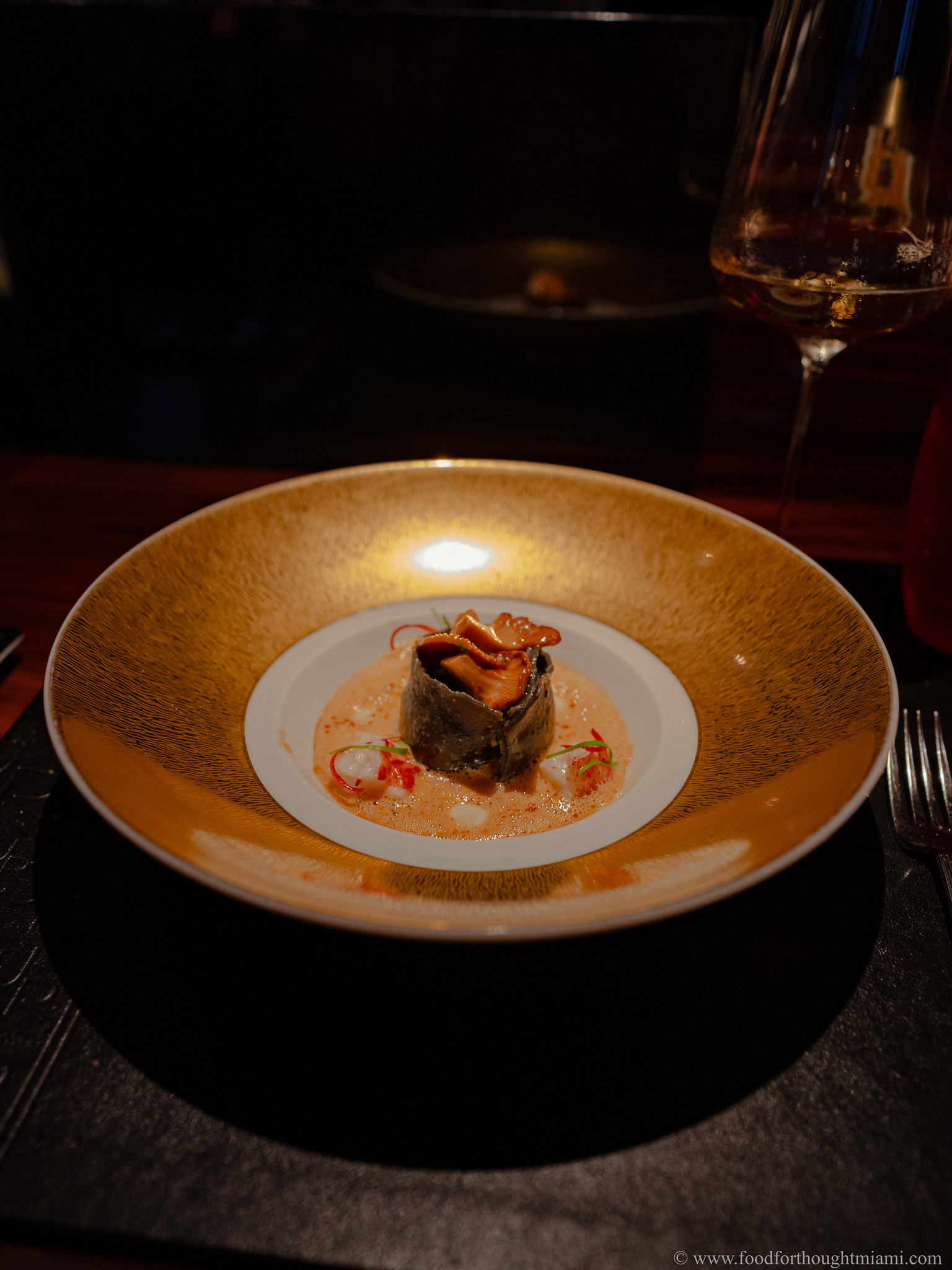
I really wanted to go to Den, which is a favorite of many smart folks whose opinions I trust. I also really wanted to go to Florilege, which is one of the top examples of French-influenced Japanese cooking in Tokyo. Turns out chefs Zaiyu Hasegawa (Den) and Hiroyasu Kawate (Florilege) opened a restaurant together! (Cue: Combination Pizza Hut and Taco Bell). Den Kushi Flori is the product of their combined efforts, with an 8-course tasting menu that features several things served on skewers,[6] served at a dining counter that wraps around a big open kitchen so chefs can bring dishes directly to the diners. This was a really fun and tasty meal, the vibe of which is encapsulated in this dish which combined a frothy, intensely-flavored shrimp bisque with a crispy-outside, creamy-inside taro croquette. A little French, a little Japanese, a little something on a stick, a lot delicious. Honorable mention to the shirasu (whitebait) rice topped with shirako (cod milt) bathed in an escargot-style garlic and parsley butter.
 |
| dashi, crab cake, bamboo shoot - Gion Nishikawa (Kyoto) |
Down a stone path in Kyoto's historical geisha district, just a couple blocks from Yasaka Shrine, in an old tea house, sits Gion Nishikawa. Chef Masayoshi Nishikawa and a small team work on one side of a hinoki counter, preparing a multi-course kaiseki dinner that features an encyclopedia of techniques and seasonal ingredients. Our February visit included fugu in multiple guises (its flesh paired with steamed turnips in a hollowed-out orange; slivers of its skin encapsulated in a jellied broth; creamy fugu shirako over rice with grated bottarga on top), delicate flounder sashimi with baby onions, ankimo in a rich nitsuke sauce with bear[7] yakiniku, among other things. But my favorite was among the most elemental of the dishes: a bowl of clear dashi, with a fluffy crabcake and young bamboo shoots. Nishikawa brings in wild kombu from Hokkaido to make the dashi, but it's also precision and technique that make for a broth so clear and delicate while simultaneously so vivid and intense in flavor.
(All my pics from Gion Nishikawa).
(All my pics from Gion Nishikawa).
 |
| sabazushi - Nominokoji Yamagishi (Kyoto) |
Chef Takahiro Yamagishi's flagship, Tominokoji Yamagishi, has one of the highest Tabelog rankings[8] of any Kyoto kaiseki restaurant. But the kaiseki experience is not for everyone, and not for every night, and there's only so many kaiseki meals I can do on one trip and stay married. So we instead went to his more casual izakaya, the similarly named Nominokoji Yamagishi. It was awesome. The seating is all around a counter facing an open kitchen. The menus are only in Japanese, and hand-written, and mostly just befuddled every translation app I had on my phone. The crew spoke virtually no English. We managed just fine. Pristine sashimi of tai and buri. Crispy fried fugu. A little mini-bowl of oden with braised daikon and yuba. A beautifully burnished, meaty grilled chicken wing. Creamy potato salad spiked with iburi gakko (smoked daikon pickles). Airy tempura spring onions. But what I had my eye on the whole meal was the sabazushi – pickled mackerel pressed over rice, which they would slice from a big roll and sear with binchotan charcoal to order. This is a word in Japanese that I know – it's one of my favorite dishes. I'd ordered it. It didn't come. I worried. Then – literally for a post-dessert, after bringing out the pudding – chef comes by and asks, "Sabazushi?" Yes, please. I have never felt more seen.
(continued ...)