Showing posts sorted by date for query eating house. Sort by relevance Show all posts

Sunday, September 13, 2026

The Best Things I Ate in 2025 - Everywhere Else

Well, it finally happened – nine months into 2026, and I got around to posting my favorite dishes from last year. Now that we're back in action, let's try to keep some momentum going. In a little change to the usual routine, things are divided into the South Florida post from earlier, and now here, all the other good things from elsewhere that we ate in 2025. We covered a lot of ground last year: a much-awaited return to Japan, more than a decade after our first visit; short trips to Cape Town and Copenhagen; and even shorter trips out to the Bay Area and up north to Philadelphia, NYC and Hudson Valley.

Looking back on these meals makes me think about something that has once again become a hot topic in the food world. It seems that every five years or so, someone writes an obituary for fine dining or, relatedly, its close cousin the tasting menu. This time around, the one tolling the bell is one of its primary practitioners: chef Bruno Verjus announced in an instagram post this week that he is closing his Paris restaurant, Table, after holding two Michelin stars for the past five years and climbing his way up the "World's 50 Best Restaurants" list.[1] In the announcement he says, "I want great ingredients. Great cooking. Great ideas. Great hospitality. But simpler. Faster. More affordable."[2] This was followed by an interview in with he formally made this year's "Fine dining is dead" proclamation. And he's not alone. Just a few weeks ago, I saw a story querying, "Does Gen Z Have the Patience for Fine Dining?," including insights from Dominique Crenn (Atelier Crenn), Matthew Kammerer (Harbor House), Charlie Mitchell (Saga), Flynn McGarry (Cove), and E.J. Lagasse (Emeril's).[3] For the contra position, a story on the Resy website just claimed that "Today's Tasting Menus Have Evolved With Something for All of Us".[4]

For whatever it's worth, my experiences over last year (and more recently) would suggest that rumors of the death of fine dining have been greatly exaggerated. But – as some others have said – what "fine dining" means, or what it ought to mean, may be changing. And that's a good thing. Does it require tasting menus with courses running into the double digits that invariably feature caviar and truffles and wagyu? Does it require multi-million dollar spaces with collectible original artworks? Does it require pressed white linens at every table?  No. No. No. Every meal featured on this list was exceptional, memorable, special. Some were indeed at posh tasting menu temples. Others were at izakayas and casual counters and tables. Some featured combinations I'd never encountered before. Others were iterations of recipes that are hundreds of years old. 

One thing I definitely notice – and this may be more indicative of how my own interests have started to skew, rather than any trend – is that many of them were driven by the ingredient itself, more so than any showy, multi-component presentation. I also notice something that is not ever gong to be captured in any picture or even any recap of a particular dish: so many of these meals were made that much more special by a kind, thoughtful gesture from a chef or server: squeezing us in for an early seating at the counter in a fully-booked restaurant, a final bite of an item I'd been longing for the entire night, a comical pantomime that transcends language barriers. There's one quote from Charlie Mitchell which I think nails something about the current AI-infected zeitgeist: "The value of real-life experiences is still high."

So yeah: maybe I too want great ingredients, great cooking, great ideas, and great hospitality, simpler, faster and more affordable. But even so, sometimes I do want to see a chef stretch his wings, take chances, maybe even just indulge. We don't need to kill fine dining to move forward – perhaps just be a little more expansive in what that phrase means.   

As always, a disclaimer: this does not purport to be a definitive “best of” list, only a very personal accounting of my favorite things over the last year. While this particular post follows my travels, the primary focus here is on South Florida. And there are typically way too many footnotes. A new one for this year: em-dashes notwithstanding, all content here is generated by an actual human who pays for all his meals. These first few rounds are going to be pretty Japan-intensive. If you don't like that, well I'm not sure we can be friends, but you can just scroll down a bit. 

nodoguro nigiri - Sushi Satake (Tokyo)

Chef Takeshi Satake spent 25+ years at Kyubey (which seems to be a particularly prolific training ground for Tokyo itamaes who go on to start their own places) before opening Sushi Satake in Ginza. While many omakase sushi progressions tend to go from lighter to richer neta, Satake does something different. When the rice first comes out and is still warm, he goes with the bigger flavors, and as the rice cools he moves to the more delicate ones. The pattern repeats over the meal as the rice is replenished. So after several rounds of otsumami, including a very nice eel nanbanzuke[5] and a hearty, intense ankimo (monkfish liver) with nitsuke sauce, the first bite of nigiri was chu-toro (medium fatty tuna), followed by buri (winter yellowtail), then hirame (fluke), then hokkigai (surf clam). Then warm and rich again, with this nigiri of nodoguro (black-threat sea perch), a surprisingly lush, fatty white-fleshed fish, lightly torched to bring out those fats and slightly crisp the skin. It's one of my favorite fish and this was one of the best iterations I've ever tasted.


shrimp bisque, taro croquette - Den Kushi Flori (Tokyo)

I really wanted to go to Den, which is a favorite of many smart folks whose opinions I trust. I also really wanted to go to Florilege, which is one of the top examples of French-influenced Japanese cooking in Tokyo. Turns out chefs Zaiyu Hasegawa (Den) and Hiroyasu Kawate (Florilege) opened a restaurant together! (Cue: Combination Pizza Hut and Taco Bell). Den Kushi Flori is the product of their combined efforts, with an 8-course tasting menu that features several things on skewers,[6] served at a dining counter that wraps around a big open kitchen so chefs can bring dishes directly to the diners. This was a really fun and tasty meal, the vibe of which is encapsulated in this dish which combined a frothy, intensely-flavored shrimp bisque with a crispy-outside, creamy-inside taro croquette. A little French, a little Japanese, a little something on a stick, a lot delicious. Honorable mention to the shirasu (whitebait) rice topped with shirako (cod milt) bathed in an escargot-style garlic and parsley butter.


dashi, crab cake, bamboo shoot - Gion Nishikawa (Kyoto)

Down a stone path in Kyoto's historical geisha district, just a couple blocks from Yasaka Shrine, in an old tea house, sits Gion Nishikawa. Chef Masayoshi Nishikawa and a small team work on one side of a hinoki counter, preparing a multi-course kaiseki dinner that features an encyclopedia of techniques and seasonal ingredients. Our February visit included fugu in multiple guises (its flesh paired with steamed turnips in a hollowed-out orange; slivers of its skin suspended in a jellied broth; creamy fugu shirako over rice with grated bottarga on top), delicate flounder sashimi with baby onions, ankimo in a rich nitsuke sauce with bear[7] yakiniku, among other things. But my favorite was among the most elemental of the dishes: a bowl of clear dashi, with a fluffy crabcake and young bamboo shoots. Nishikawa brings in wild kombu from Hokkaido to make the dashi, but it's also precision and technique that make for a broth so clear and delicate while simultaneously so vivid and intense in flavor.

(All my pics from Gion Nishikawa).

sabazushi - Nominokoji Yamagishi (Kyoto)

Chef Takahiro Yamagishi's flagship, Tominokoji Yamagishi, has one of the highest Tabelog rankings[8] of any Kyoto kaiseki restaurant. But the kaiseki experience is not for everyone, and not for every night, and there's only so many kaiseki meals I can do on one trip and stay married. So we instead went to his more casual izakaya, the similarly named Nominokoji Yamagishi. It was awesome. The seating is all around a counter facing an open kitchen. The menus are only in Japanese, and hand-written, and mostly just befuddled every translation app I had on my phone. The crew spoke virtually no English. We managed just fine. Pristine sashimi of tai and buri. Crispy fried fugu. A little mini-bowl of oden with braised daikon and yuba. A beautifully burnished, meaty grilled chicken wing. Creamy potato salad spiked with iburi gakko (smoked daikon pickles). Airy tempura spring onions. But what I had my eye on the whole meal was the sabazushi – pickled mackerel pressed over rice, which they would slice from a big roll and sear with binchotan charcoal to order. This is a word in Japanese that I know – it's one of my favorite dishes. I'd ordered it. It didn't come. I worried. Then – literally for a post-dessert, after bringing out the pudding – chef comes by and asks, "Sabazushi?" Yes, please. I have never felt more seen.


(continued ...)

Monday, August 31, 2026

The Best Things I Ate in 2025 (Remember 2025?) - South Florida

I don't know if anyone noticed, but there are only four months left in 2026. Maybe it's time that I actually dusted off and finished this "Best Things I Ate in 2025" post before another year goes by? Obviously, the mission here has never been to breathlessly gush about the latest openings, but this has clearly gotten a little out of hand. So here's my attempt to kick some life into this blog, and start to catch up.

There are some consequences to delay, and one of them is that some of the places that appear in this list are now gone. Itamae AO. Awarded a Michelin star, chef Nando Chang named James Beard Foundation Best Chef - South in 2025. Entrenos. Also awarded a Michelin star. Both closed in 2025. They each had their reasons, entirely unrelated to the quality of the food and experience. Nando's reincarnation of Itamae as an omakase counter inside sister Val Chang's wonderful restaurant Maty's (Val herself was named Beard's Best Chef - South the prior year) had to close when Maty's shut down last summer – likely a victim of a mismatch between concept and venue, a very large and probably very expensive space in Midtown Miami. And Entrenos was always intended as an impermanent pop-up inside the Tinta y Cafe space in Miami Shores. Since then, chef Osmel Gonzalez went north to open Emelina in West Palm Beach (which itself picked up a Michelin star this year), and now chef Evan Burgess is in process of opening a new restaurant, Yonder, in Coral Gables.

In retrospect, 2025 turned out to be a pretty brutal year for the industry. Longtime stalwarts like Cafe Vialetto, Osteria del Teatro, Sardinia, Sugarcane, La Mar, Le Zoo, and Harry's Pizzeria all appeared in the restaurant obituary columns. So did a bunch of big-name newcomers like New York's Red Farm and Ensenada, Henrique Sa Passoa's Sereia, and Gordon Ramsay's Lucky Cat. All opened in 2024, none made it through 2025. It's tempting to try to discern some broader lesson: Miami rents and operating costs are too high, the market is too oversaturated, Miami diners are too fickle. There is some truth to all of those. If anything, it seems to me to highlight the importance of controlling costs, connecting with the local dining community, and giving people reasons to keep coming back. One thing I note is that many of the restaurants from this 2025 list that are still standing are not in the high-rent hot-spots like Wynwood and Brickell, but instead places like Little Havana, North Miami, South Miami, Little River, and North Beach.

Despite the market's challenges, last year offered some of the most interesting, inspired cooking I've experienced in Miami in quite some time, much of it from a new generation of younger chefs who were opening their first restaurants. That's genuinely exciting. I also had the good fortune to travel, and eat, very well last year outside of Miami, including a return trip to Japan, and visits to Cape Town, Copenhagen, the Bay Area and Hudson Valley. As always, a disclaimer: this does not purport to be a definitive “best of” list, only a very personal accounting of my favorite things over the last year. It is South Florida focused, but follows me around as well when we travel. And there are typically way too many footnotes. A new one for this year: em-dashes notwithstanding, all content here is generated by an actual human who pays for all his meals. We're going to do things a little different this year – let's start with the South Florida list, and then do a second round with all the rest of the ground we covered last year. Let's get on with it!

stone crab rice - Itamae AO (Midtown Miami)

Way back in 2017, I went to a one-off pop-up dinner called "Nisei" with a young chef cooking a menu from a genre I was just then starting to grasp: nikkei, the mash-up of Peruvian and Japanese flavors that is a sort of organic example of "fusion" cuisine. The chef (and part-time hip-hop recording artist) was Nando Chang, who I continued to follow as he went from food-hall kiosks to a mostly open-air space in the Design District to the omakase counter he opened as Itamae AO. Every iteration was an improvement and refinement, and every meal was better than the last. This dish is a great example, bringing Florida into the Peruvian-Japanese mixtape: local stone crab, a claw draped with anticuchera sauce, sitting atop a bowl of creamy rice enriched with more crab, chile and herb oil. Unfortunately, this would turn out to be one of the last bites from my last meal at Itamae AO. Nando has been popping up here and there for collaboration dinners since the closing – I'm eagerly waiting for the next track to drop.


ballyhoo - Recoveco (South Miami)

There is such a confidence in the cooking of Maria Teresa Gallina and Nico Martinez, the co-chefs and partners who opened Recoveco, that it is hard to believe it is their first time running their own restaurant. The menu is short – typically four apps, four mains, two desserts. While operating within this self-circumscribed universe, it's also typically pretty weird: one of the staples is chicken-liver mousse over speculoos crackers dotted with tropical fruit jam (could be guava, maybe starfruit, depending on what's growing); what's called "papaya salad" is a mutant hybrid of Thai som tum and Italian (actually Mexican) Caesar. And when it's not weird, it's often pretty minimalist: another staple is their "golden chicken," an Amish bird simply but expertly roasted, maybe served with a piri piri buffalo sauce. But both concept and execution are so consistently, and uncannily, on target that this has become one of my favorite restaurants to visit. This dish of ballyhoo (typically used locally as baitfish, though it's of the same family as Japanese sayori, a/k/a halfbeak) is a great example: the shiny fish fileted, cured, and cut into bite-size pieces, dappled with a white soy and sweet potato vinegar ponzu, and accompanied by a dab of fresh wasabi. Nowhere to hide; no need to.


snow crab, corn, uni & caviar chawanmushi - Omo by Jont (Orlando)

We took the Brightline north to spend a weekend in Orlando, which has long been a haven for excellent Vietnamese food, and has more recently made leaps and bounds in all sorts of other kinds of dining experiences. We have a lot more exploring to do, but on this visit the primary focus was Omo by Jont. Its chef is Ryan Ratino, who has the Michelin two-starred Jont and one-starred Bresca in Washington DC, opened MAASS in Fort Lauderdale in late 2023 (which appeared in my 2024 list, and picked up its own star last year), and then Omo a few months later (which also picked up a star last year). Normally I would be very skeptical of this expansionist approach. But from my experiences at MAASS and Omo, it seems Ratino has some good systems, and good crews, to maintain quality control across his multiple venues. Omo is a really nice experience: the meal starts in a cozy lounge area with several small bites, moves to a dining counter in the open kitchen for several more courses, then finishes with dessert in another little lounge area. Over maybe 18 different bites, there were no misses and several highlights, the most memorable being this chawanmushi with snow crab, sweet corn, Hokkaido uni and caviar.[1]


aori ika with osetra caviar - Ogawa (Little River Miami)

Miami has seen an influx of high-end omakase venues recently. Some of these are better than others. Ogawa, in Little River, is among my favorites. Over the past several years, restaurateur Alvaro Perez Miranda has opened several Japanese spots that hit multiple points of the market: the casual Wabi Sabi (now called Midorie 79, with a sibling in Coconut Grove), the somewhat higher-end Hiywakawa, and the all-out Ogawa. Given the price (currently $395, which includes tax and service charge), it is definitely a "special occasion" spot, while I'm at Midorie 79 nearly every other week. But in my opinion, it's worth it on those special occasions. The narrow dining room with one long counter, in a building that backs onto the railroad tracks, makes me feel like I'm back in Japan. And with chef Masayuki Komatsu behind the counter, usually accompanied by Royce Appling, and sometimes Jamie Liu in the kitchen, the food gives me those feels too. The dishes change with the seasons – during this spring visit, ayu (sweetfish) tempura, sayori (needlefish) nigiri, and sakura masu (cherry trout) nigiri were all featured – but one nigiri that seems to hold steady is this one featuring aori ika (big fin reef squid) topped with a generous dollop of osetra caviar. It's a great combination: the squid slightly sticky and sweet, playing against the pop and salinity of the roe. I'm not generally a fan of the intrusion of "luxe" ingredients into every pricey omakase lineup – save your caviar and truffles and wagyu and toro, give me something perfect and peak of season instead – but this one works.


(continued ...)
Saturday, May 24, 2025

The Best Things I Ate in 2024 (Round 1)

Is May too late for a “year in review” post? Last year, I was asking this question in February, so the trendline is becoming clear. I hope you'll excuse my tardiness, as 2024 was an interesting year for the Miami dining world, and as usual, I have some thoughts, even if I'm only getting around to posting them several months into 2025.

Speaking of trendlines, I saw several in the past year. Maybe most notable is the massive influx of outsiders. After Miami had its moment in the sun in 2023 – Bon Appetit naming it “Food City of the Year,” local restaurants and chefs getting recognized in NY Times’ “Best Restaurants of 2023,” Esquire’s “50 Best New Restaurants,” and Food & Wine’s “Best New Chefs”  – the boom was inevitable. While those kudos went mostly to locally-grown products, the wave that followed, as is often the case here, came mostly from without and not within.

Restaurant operators from New York, Chicago, California, Europe, Canada and Latin America have moved into South Florida like a swarm of mosquitos. Only a small handful made this list. Prominent among the new additions were a lot of big ticket Italian places, most of which, honestly, I’ve blissfully ignored.[1] Of the ones I have tried, the most notable and interesting was Torno Subito, chef Massimo Bottura’s brightly-colored, playful spot downtown atop the Julia & Henry food hall. And yes, I will acknowledge that a Michelin three-starred,[2]World's 50 Best Restaurants” first-place chef opening a restaurant in Miami is officially a Big Deal. But it didn’t make the list.

As usual, the trends I’m more interested in stay closer to home, and one that I found particularly encouraging was the opening of several inspired, independent restaurants with their own distinct styles. It may be odd to call a handful of new spots that are quite different from each other a “trend,” but the places I’m talking about – Itamae AO, Palma, Recoveco[3] in particular, though there are others – while dissimilar in style, share a focus on great ingredients, thoughtful cooking, and maybe most importantly, their own particular culinary expression. I also put the wonderful EntreNos in this group, even if it doesn’t perfectly fit the timeline as a late 2023 opening.[4] I was very happy to see EntreNos recognized with a Michelin star last year, along with new stars for deserving omakase venues Ogawa and Shingo.[5]

And speaking of omakase: much as I’m a fan, it is probably a good thing that the barrage of new omakase openings seems to have tailed off some. I have my favorites – yes Ogawa, and yes Shingo, and I am quite overdue for a return visit to Naoe – but let’s just say I am not convinced of the sincerity of all these spots. One that I did very much enjoy, and which made this list, was the Inoshin pop-up at the Surf Club. Chef Shinichi Inoue is the real deal.[6]

2024 was also a good year for reboots, the most impressive of which has been Sunny’s. The pandemic pop-up always would have had a special place in my heart, as I still recall the feeling of hope and civility it restored in some particularly weird times. But wow, talk about a “glow up.” More to come on that later. Other exciting reboots: the return of Michelle Bernstein’s Sra. Martinez, now in Coral Gables after a decade-plus hiatus; Niven Patel bringing Ghee back to us folks for whom Kendall is a different country (not quite in the Design District, but close by in Wynwood); and Kojin 2.0, also now in the Gables (in the old Eating House and briefly Lion & the Rambler spot), which I am due to pay a visit.[7] 

Anyway, before another year goes by, on to the list. As always, a disclaimer: this does not purport to be a definitive “best of” list, only a very personal accounting of my favorite things over the past year. It is South Florida focused, but follows me around as well when we travel. And there are typically way too many footnotes.

HM ribeye - EntreNos (Miami Shores)

At EntreNos, chefs Evan Burgess and Osmel Gonzalez do some fantastically creative things – turning unripe green mangos into olives, using fish like blue runner, more often treated as baitfish here, in delicious crudos. They also do some very simple things very well. This big-boy ribeye, from HM Cattle Company in Central Florida, is one of the best locally raised steaks I’ve ever had – seasoned and cooked perfectly, and accompanied in minimalist fashion by some pickled vegetables, crispy yucca, and fresh leaves dressed in a sharp vinaigrette. It’s unusual to see young chefs exercise this kind of restraint. Like the motto of one of my favorite restaurants, Rustic Canyon in Santa Monica, says, “Simple Ain’t Easy.”


le bison - L'Atelier de Joel Robuchon (Miami Design District)

It is something of an anniversary tradition for Mrs. F and I to celebrate at an Atelier de Joel Robuchon, going back more than a decade to a visit to L’Atelier Tokyo for #20. The Design District spot is Miami’s only Michelin two-starred restaurant, and curiously, the only U.S. restaurant in the Robuchon empire with more than one star. While I’m not sure I can explain that quirk, I can say that L’Atelier reliably delivers what it sets out to do: French cuisine that is contemporized but far from revolutionary, prepared with precision. This Wellington variation is a great example: bison – lean but flavorful, and with a perfect cook – in place of the usual beef, layers of Swiss chard and mushroom duxelles, a crisp laminated pastry shell, a classic red wine jus.


Spaghetti alla Moro - Trattoria al Moro (Rome, Italy)

A slightly belated anniversary trip took us to Italy, starting in Rome, which is one of my favorite eating towns in the world. Our first-night meal was at Al Moro, an old guard spot just steps from Trevi Fountain. We were somewhat brusquely shuffled into a room that was clearly earmarked for tourists, where everyone was squeezed into one long banquette, and yet I found the place completely delightful. Especially the house signature “Spaghetti alla Moro,” essentially a carbonara with the addition of some hot chili flakes. Nothing fancy, just a great dish, perfectly done.


sbagei - Trattoria la Grotta (Riomaggiore, Italy)

I was led to believe that while the views in Cinque Terre are fantastic, the food was not so much. Still and yet, there were some local specialties I quite enjoyed – anchovies in all sorts of variations, lovely stuffed mussels in a spicy tomato sauce. But the most interesting, and unexpectedly delicious thing we ate was this dish of sgabei – a frybread with origins in Lunigiana, a region bordering Liguria and Tuscany – accompanied by dried tuna bresaola and a quenelle of prescinseua, a soft, fresh Ligurian cheese.


calamari in zimino - Ora d’Aria (Florence, Italy)

In Florence, we paid a visit to Ora d’Aria, a restaurant run by chef Marco Stabile, who for a time was also associated with Miami’s Toscana Divino. It is a posh place – gold-rimmed white china and pressed linens – but the food actually pays tribute to a much humbler style of cooking. When you start a meal with a teacup of cavolo nero brodo – pot-likker, basically – you have won my heart. Nothing is deconstructed or reinvented or a “play” on anything here, it’s just cooked really well. Kale also played a feature role in my favorite dish there, a stew of tender baby calamari in zimino stewed in a dense, hearty green broth.


pici all’aglione - Osteria il Borro (Arezzo, Italy)

We headed into the Tuscan countryside for a couple days to Il Borro, an absolutely magical estate near Arezzo which incorporates an old medieval village. They make excellent wines, they run a farm, they have cooking classes, all in a jaw-droppingly beautiful setting. During the day we learned to make pici, the rustic hand-rolled Tuscan pasta. At night we ate the professionals’ version of the dish, dressed with garlic, herbs, pepperoncini and anchovies. Much better than mine.


nigiri omakase - Wabi Sabi (Miami Upper Eastside)

Sometimes you want a great sushi dinner, but you don’t want to spend $200-$300 a head. Crazy, right? When that craving hits me, which is often, you will find me at Wabi Sabi, where the omakase platter offers a dozen pieces of nigiri plus a maki roll for $100. This is not a “cheap” meal by any means. But this is also a chance to dine on high quality fish, flown in from Japan, the selection changing with the market and the seasons, prepared with care and attention. It is exponentially better than many of the places selling commodity-grade sushi for the same prices, while still a fraction of the cost of Miami’s top sushi-yas. I feel incredibly fortunate to have this so close to home. Gochisosama!


(continued ...)
Sunday, February 18, 2024

The Best Things I Ate in 2023 (Round 2)

February isn't too late for "year in review" posts, is it? Not too late for me, anyway. Round 1 of my favorite dishes of 2023 actually made it up within a week of the new year. This sequel has experienced some delays, but is now resuming regular service. In the first post, we ventured through Oakland, Scotland, London, Lisbon and Marrakech before finding our way back home. Here, we pick up where we left off back in Miami – with one of my favorite new local restaurants.

bluefin tuna tiradito - Maty's (Midtown Miami)

How gratifying was it to see a huge picture of this beautiful dish splashed across the landing page of New York Times' list of "America's Best Restaurants 2023"? This was the year the national media really caught wind of the great things the Chang Gang are doing down here, as I noted in Round 1 while singing the praises of Nando's spot, Itamae. It took me a few months after it opened to get to sister Val's new restaurant, Maty's, but by the time I visited it was absolutely firing on all cylinders. While Itamae skews more towards the Japanese influences on Peruvian cuisine, Maty's sticks with a more "traditional" repertoire - cebiches, tiraditos, jaleas and saltados feature prominently, but done in a finessed and contemporary way. 

scallop cebiche - Maty's (Midtown Miami)

Pretty much every dish felt like a highlight, but I was especially fond of that tiradito which made the NYT cover, of bluefin tuna in an aji limo leche de tigre with canary beans for some earthy grounding and beads of finger lime to provide a little extra acidic pop. Also, this cebiche of delicate scallops in a scotch bonnet leche de tigre with cilantro oil and coins of slivered grapes for a sweet-sour contrast. Great ingredients, lots of legumes and vegetables, and bright flavors that almost ripple with electric energy. This was one of the most exciting, invigorating meals I've had in a while. 


tostada de anchos - Bar Gilda (Miami Beach)

Over the summer, chef Juan Garrido was popping up Mondays and Tuesdays at Tropezon on Española Way with a pintxos-themed menu called "Bar Gilda". The rotation would change a bit from week to week, featuring staples like the namesake gilda,[1] tortilla española, patatas bravas, and bocatas de calamares, with occasional detours. I thoroughly enjoyed every single bite – especially these delightful toasts of Cantabrian anchovies, fancy butter, and a sharp, fresh parsley-garlic dressing, mounted over crisp puff-pastry crackers. A classic combination, and an ode to really good ingredients. Having now recalibrated my pintxos-meter with a visit to the motherland later in the year, I can say that this as close to a real-deal Basque pintxos bar as I've experienced in Miami.


le homard - L'Atelier de Joel Robuchon (Miami Design District)

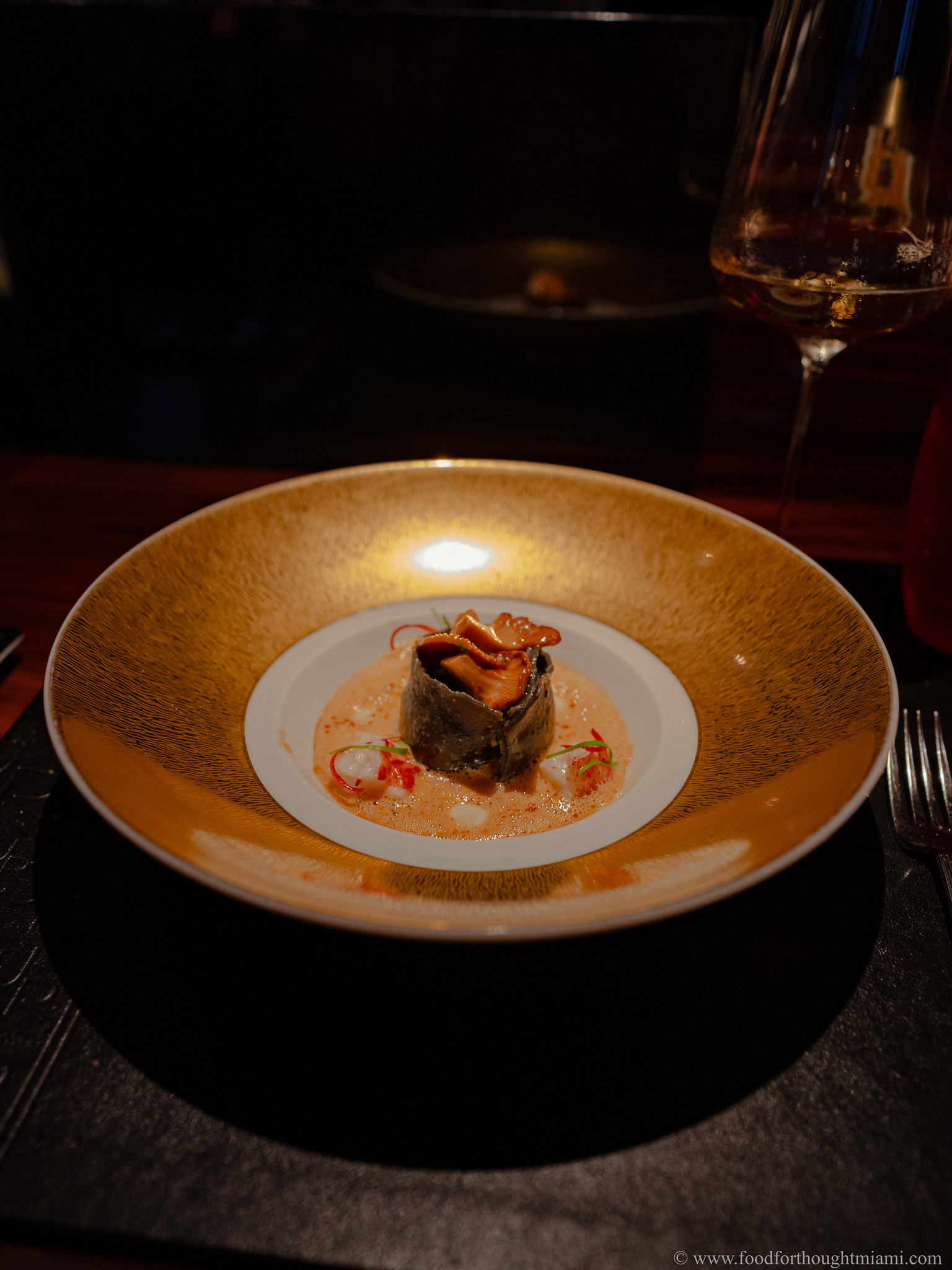
It had been a minute since I'd last visited L'Atelier, the Joel Robuchon outpost in the Design District, and the only Florida restaurant which has been bestowed two stars in the Michelin Guide. The design of the Atelier restaurants is consistent throughout their locations around the globe, and for me anyway, there's still something slightly surreal about encountering the distinctive shining black, red, polished wood and gleaming chrome dining room and open kitchen here in Miami. There are a few ways to experience the Miami L'Atelier – the "Evolution" tasting menu, a shorter seasonal menu with a couple options for each round, some classic "specialties" that can be added on, and even a straight a la carte menu on weekdays. From an early fall seasonal menu, my favorite dish was this spiral agnolotti with lobster and chanterelle mushrooms, swimming in a rich, powerful lobster bisque.

Comparing the ratings of the Ateliers around the world is a curious exercise. The "flagship" Atelier in St. Germain, Paris has one star, as does a second location in Etoile, Paris as well as the Tokyo outpost. Meanwhile, the Miami Atelier has two stars, as do the ones in Geneva and Taipei. The Atelier in Hong Kong has three stars! The ones in London, Madrid and Dubai have none. What does it all mean? That you can get a better meal at an Atelier in Hong Kong or Miami than at one in Paris? That Michelin is grading on a curve when it awards stars in different cities? That maybe the stars are kind of arbitrary? Inquiring minds want to know!


akamutsu, buro - Mila Omakase (Miami Beach)

Miami has seen a boom in high-priced omakase venues over the past few years, and I am far from convinced that they all are capable of delivering on their sometimes vertigo-inducing tariffs.[2] So I approached Mila Omakase with a healthy degree of skepticism. Also, Mila, the main restaurant in which it makes its home, seems like a douchebag magnet? But after clearing our way past the hostess stand and entering the insulated inner sanctum of the omakase room, where a cherry blossom tree overhangs the sushi counter, I was very pleasantly surprised. Chef Reiji Yoshizawa and his crew show some solid technique and use some very good ingredients, but what I was particularly enamored of were the occasional flashes of Filipino flavors that appear here and there (Chef Yoshizawa grew up in Manila). It showed up in one of the opening bites, a canape with creamy kinilaw flavors in a crispy round shell. And it came around again with a nigiri of lightly torched akamutsu[3] topped with a daub of buro, a rich, funky fermented shrimp and rice paste, which nicely complemented the pleasingly fatty fish.


spiny lobster chawanmushi - EntreNos (Miami Shores)

Maybe the most exciting newcomer of the year for me is EntreNos, an extended pop-up at Tinta y Cafe in Miami Shores by chefs Evan Burgess and Osmel Gonzalez. The two chefs both did time at Michael Beltran's Ariete, and Evan's resume also includes Miami's late great Alter and Chicago's Boka restaurant group, while Osmel spent time on the west coast as sous chef at one of my favorite places, SingleThread in Healdsburg. Back home and together, they are focusing on local products through a short, tightly curated menu with a dedication and creativity I have rarely seen here. A crudo uses blue runner, a dark-fleshed local fish in the jack family used more often as bait than as dinner, but which when sourced and handled well, as here, is deliciously rich and meaty. Accompaniments include a carambola vinaigrette, local leaves and blooms, and another thing I've never seen done with a local product — mango "olives" made by brining young, unripe mangoes. Oysters from Sebastian Inlet are grilled and topped with brown butter chimichurri. Desserts include a tomme cheese panna cotta topped with a sorbet of sea grapes, a ubiquitous but rarely used local product. I've had a couple different variations of their chawanmushi – one with smoked grouper, and another, pictured here, with spiny lobster. A creamy, frothy onion foam blankets the egg custard, hiding nuggets of savory confited potatoes underneath. This simultaneously triggers memories of seafood chowder (lobster / cream / potato), tortilla española (egg / onion / potato), and maybe even carbonara with the smoked grouper version (smoked fish playing the role of bacon). Regardless of what associations you may draw, it is flat out delicious.


(continued ...)

Saturday, January 6, 2024

The Best Things I Ate in 2023 (Round 1)

"Year in Review" and "Best ..." posts are tired and lazy. I know. But in their (my) defense, they're also an opportunity for some reflection and perspective, a change of pace from the ephemeral but unrelenting blare of most food media these days. When writing these posts, I'm not just trying to tick off some boxes – there's some thought that goes into deciding what dishes really brought the most pleasure and inspiration over the past year, and effort in trying to find words that capture what was special about them, occasionally even some consideration of how they might fit into some grander scheme. Plus, once a year seems to be about the pace I'm capable of maintaining here at FFT these days.

2023 was a big year for Miami dining, as far as recognition beyond our borders. Bon Appetit magazine pronounced Miami its "Food City of the Year," and followed up by naming Val Chang's new Peruvian restaurant, Maty's, one of its Best New Restaurants of 2023. The New York Times included Maty's, along with Smoke & Dough, among its Best Restaurants of 2023 (with a huge splash shot of Maty's tuna tiradito on the cover). Esquire magazine followed suit, including Maty's and Niven Patel's new Erba in its 50 Best New Restaurants. Val and brother Nando (soon to be reopening Itamae as an omakase counter inside Maty's) were both among Food & Wine magazine's Best New Chefs. And for whatever it might mean, Miami entered its second year of being a Michelin-rated town, with one addition (Tambourine Room) to the ten one-stars selected last year, and everyone else retaining their stars (including two-starred L'Atelier de Joel Robuchon).

That kind of attention draws a lot of big-money operators. Major Food Group started with a Carbone clone in South Beach in early 2021, and soon two hands may not be enough to count all their Miami restaurants. Clubster David Grutman (LIV) has become a restaurateur, with over a half-dozen venues under the umbrella of Groot Hospitality, including a team-up with Tao Group on the new Casadonna. Stephen Starr and Keith McNally opened a recreation of their New York faux-French bistro Pastis in Wynwood. Thomas Keller opened a Bouchon Bistro in Coral Gables. Chicago group Lettuce Entertain You opened the Mediterranean Aba in Bal Harbour. Toronto's INK Entertainment Group (which also runs Byblos) opened the Mediterranean Amal in Coconut Grove. Everyone and their brother opened a Mediterranean restaurant with a two-syllable name containing at least one, and preferably two, soft-a sounds in it, this past year.[1] Then their cousin opened an omakase counter with a $200+ price point.[2]

But that's not remotely the most interesting segment of the Miami dining universe these days. For me, anyway, what is most exciting to see is the resurgence of small, adventurous restaurants that don't fit into any particular mold. And not just the spots that have (justifiably) gotten so much media attention recently, like Maty's and Erba and Boia De, but pop-ups like Spanish-Japanese QP Tapas, locally-focused EntreNos, pintxos-themed Bar Gilda, Southern brunch specialist Rosie's, and pop-up-turned-permanent Vietnamese gem Tam Tam, plus quirky spots like New Schnitzel House, and Lion and the Rambler, and Aitor Berasaluze's new Edan Bistro in North Miami. Can we swap out some of the "clubstaurants" for more of these? What is the exchange rate?

As is usually the case, I'm way behind the curve. Between travel and returns to old favorites, I made it to about twenty new restaurants in Miami over the past year. Yet the "to-do" list – which is not everything that has opened, only those that actually look interesting to me – still grows ever longer. Roughly half of the dishes on this year's list are locally grown; the rest come from a variety of places we were lucky enough to visit in 2023: Northern California, England, Scotland, Lisbon, Marrakech and Spain.[3] (You want itineraries? I've got itineraries.)

Without further ado ...

ugly mushroom pasta - Pomet (Oakland)

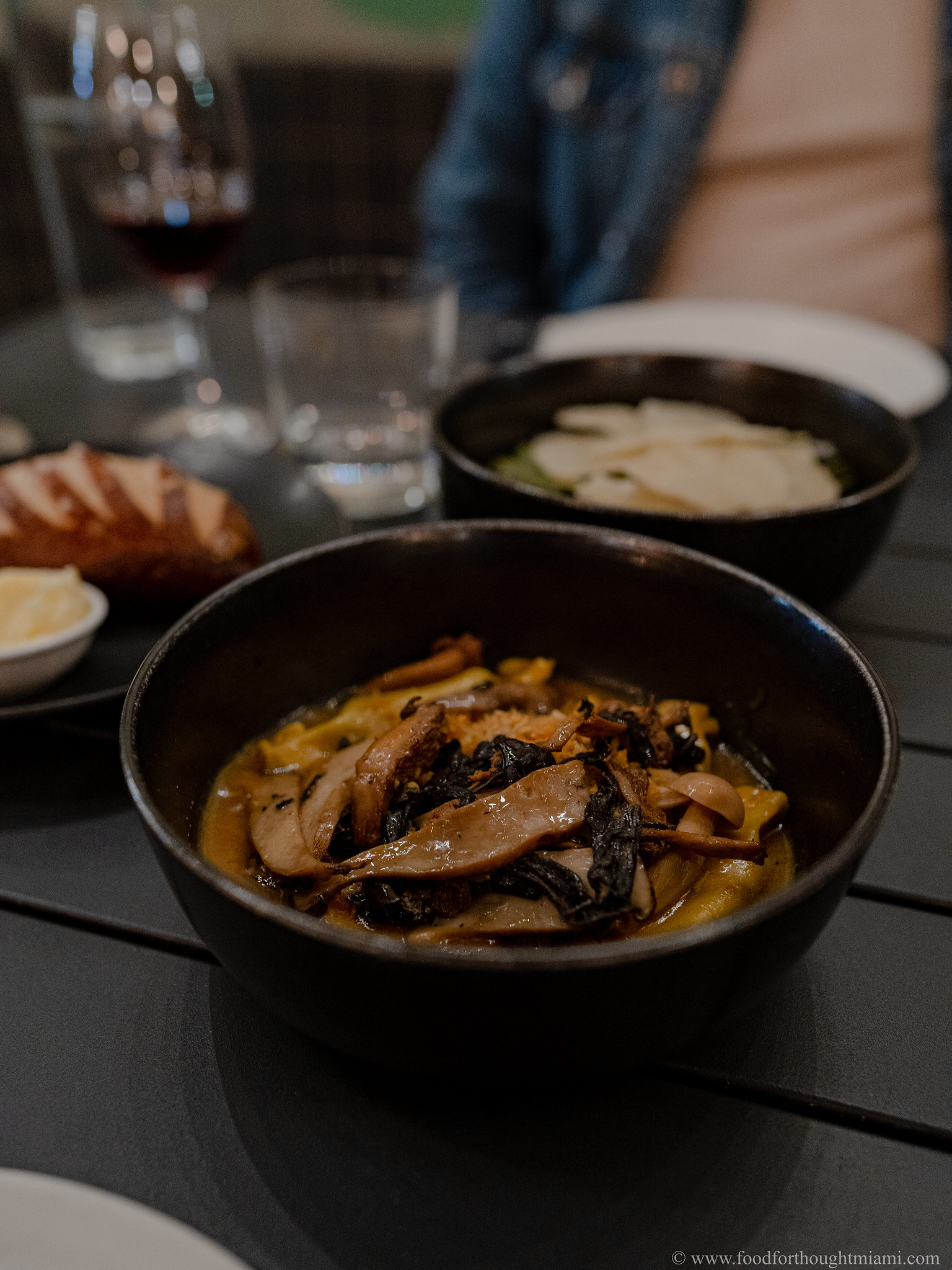
Early in the year we did an all-East Bay trip to Northern California, making the Moxy in Oakland our base camp and only passing through San Francisco to get to and from the airport. This is not one of those "San Francisco has become a cesspool" screeds (not that Oakland is spared from that stuff), but rather a recognition that some really interesting creative stuff is happening on the other side of the Bay Bridge (also Frod Jr.'s in Oakland). We had a great meal at Pomet, which turns the farm-to-table trope on its head: the restaurant was started by Aomboon Deasy, who runs K&J Orchards and wanted a place to highlight their fantastic produce. She recruited chef Alan Hsu to do the cooking and the results are pretty wonderful, highlighted by this "ugly mushroom" filled pasta smothered in an assortment of trumpets and other mushrooms and some Shared Cultures mirepoix miso butter. An umami bomb in a silky, delicate package. 


Hong Kong egg tart - Snail Bar x Gizela Ho (Rich Table) (Oakland)

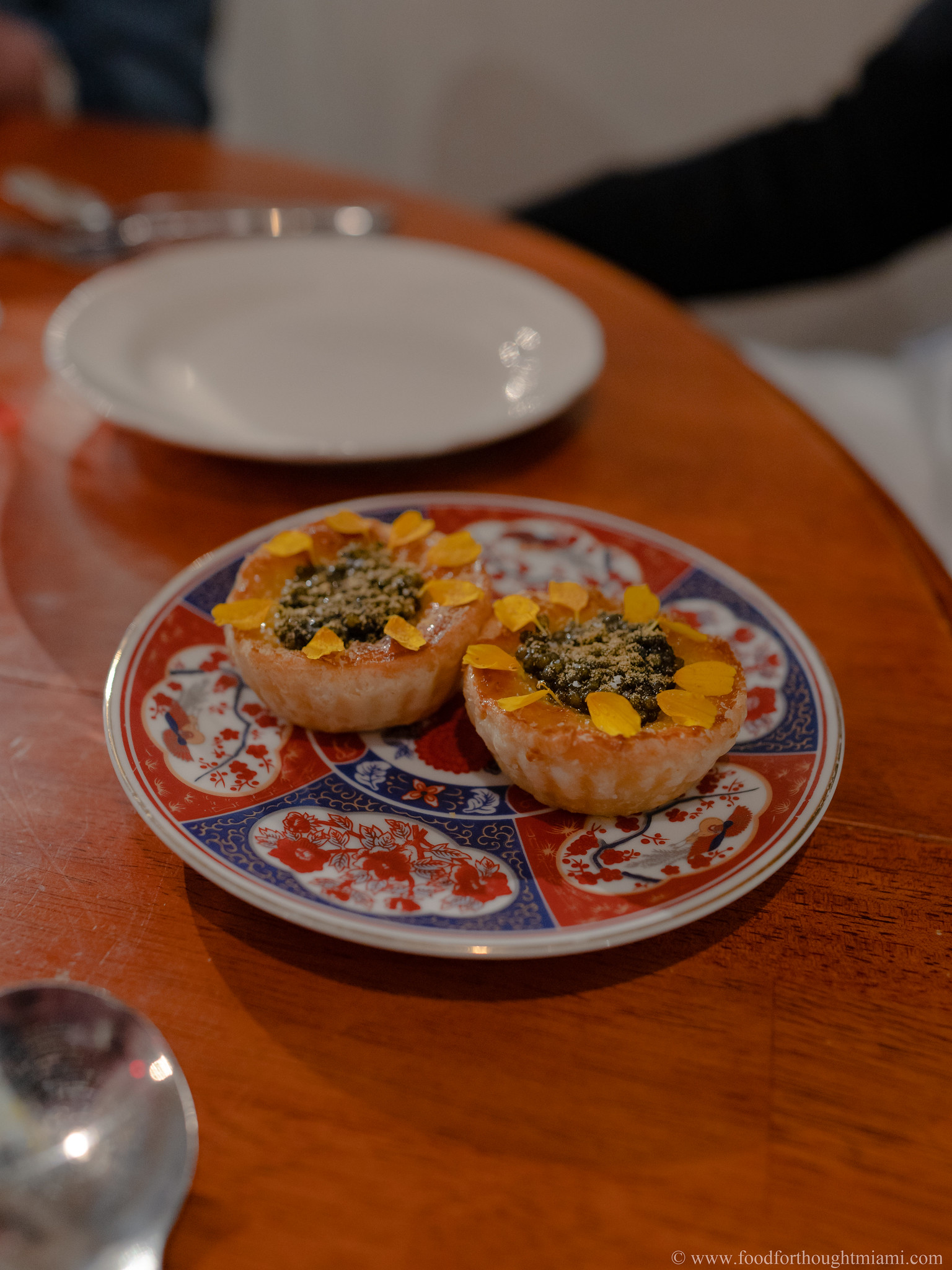
Our weekend visit to Oakland happily coincided with a pop-up dinner with Gizela Ho, CDC of San Francisco's Rich Table, at the culinarily overachieving wine bar Snail Bar. My favorite thing on the night's menu were these decadent egg tarts, flavored with chamomile and hazelnut oil, topped with oscetra caviar, and adorned with a garland of marigold petals – a traditional dish twisted in the service of new flavors. What is maybe most refreshing about the wave of new spots in the East Bay – like Pomet, Snail Bar, Day TripBurdellLion Dance Cafe – is that they aim for a more casual vibe and lower price point than the high-end temples of gastronomy that have become increasingly common in S.F., while still maintaining the focus on interesting, delicious cooking with high-quality ingredients.


Pintxo Matrimonio, Txangurro - Jaguar Sun x Ernesto's (Miami)

Back home, but sticking with the pop-up theme: early in the year, Carey Hynes and Will Thompson of Jaguar Sun did a great series of collaboration dinners at Understory in Little River. The couple I made it to were both great experiences – a seafood-themed one with Ben Sukle of Oberlin in Providence, R.I.[4], and this Basque-themed one with Ryan Bartlow of N.Y.'s Ernesto's. There were lots of good things this night, including gambas de Palamos and a rice with rabbit, mushrooms and truffles, but what really resonated for me was this very traditional pintxos platter: a "matrimonio" of black and white anchovies over a puff pastry baton, and a "txangurro" tart filled with sweet, tender blue crab cooked with a sofrito of tomato and onion. These were every bit the equal of the pintxos we had during our end-of-year trip to San Sebastian.


Celeriac, Brown Crab & Apple - Inver (Strathlachlan, Scotland)

Some meals are inseparable from the environment in which they are served. Sometimes it's because the kitchen is dedicated to sourcing from surrounding lands and waters, creating a literal connection to the environment. Sometimes it's because the locale itself is so special that it is indelibly attached to the experience. And sometimes it's both. Inver Restaurant & Rooms, in Strathlachlan, Scotland, is one of those that fits both descriptions. Our drive to Inver, situated along the Loch Fyne a couple hours west of Glasgow, proceeded along an increasingly narrow road that at one point became so wee I wasn't sure I hadn't somehow detoured onto a hiking path. Upon arriving, we found ourselves at the foot of a marsh, gazing out onto the water with the ruins of the old Castle Lachlan in the distance. What a setting.

Lodging is provided in very comfortable, contemporary bothies along the marsh; dinner is served in a spare, simple house at the end of the path. It is all exceedingly local and exceedingly delicious, like this dish with a sort of mille-feuille of celery root topped by a rich mousse of brown crab, batons of celery root and apple alongside. I could have just as easily gone with maybe the most humble, straightforward dish I was served all year: a cup of a frothy bread and butter broth with an incredibly deep, savory flavor.

You can find tasting menus stuffed with foie gras, caviar, and wagyu in just about any metropolitan city, and so many of them are going to feel exactly like each other no matter where they are. You can find roughly a dozen omakase venues just in Miami which serve fish and seafood shipped direct from the Japanese markets. What is truly rare, and special, is the meal you simply cannot get anywhere else. This is the kind of restaurant experience I'm increasingly drawn to: a place with a sense of *place*.  


(continued ...)

Tuesday, January 10, 2023

The Best Things I Ate in 2022 (Round 2)

Happy New Year, all! I actually managed to post Round 1 of the Best Things I Ate in 2022 before the calendar flipped over, so that's progress over last year. This is how I intend to approach 2023: be grateful for any tiny modicum of improvement. Round 1 started in the Bay Area before making its way back to Miami, then returned west to L.A. as it wrapped up. Round 2 starts off back in Miami again at an old favorite with a new look, and makes detours to Chicago, the Pacific Northwest and Iceland before finding its way home.
 
Seafood Platter - Michael's Genuine

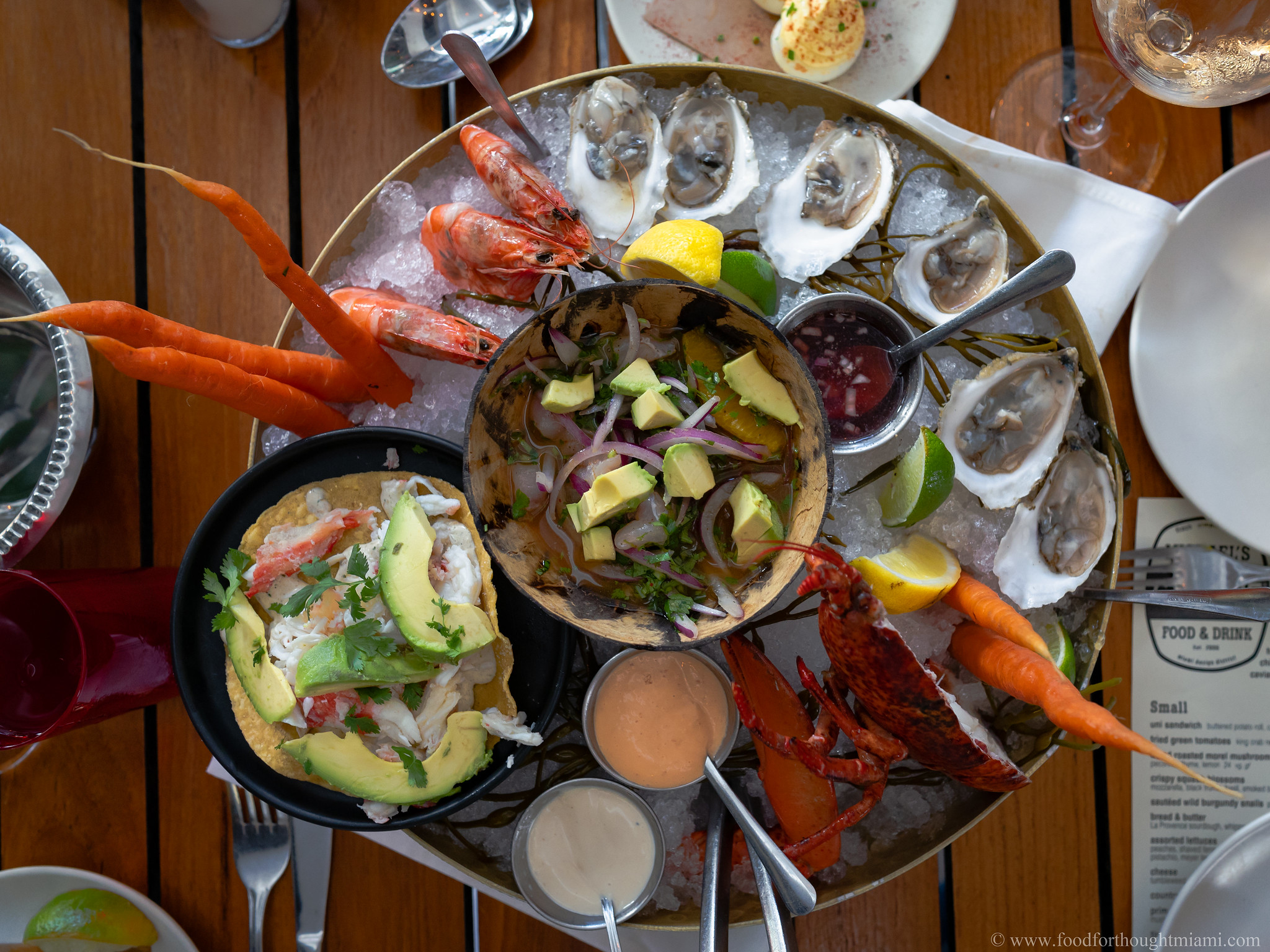
I'll confess that Michael's Genuine had fallen off my radar for a while. But over the past year it's made its way back into the rotation, with a major remodel of the space, and new chef de cuisine Dillion Wolff (who worked his way up from line cook over several years), bringing some new energy.  My most recent meals have been some of the best I've had there in several years, highlighted by this fantastic seafood platter featuring cold, briny oysters, tender poached Florida-harvested shrimp, a ceviche of whatever is fresh with citrus and kimchi flavors, crunchy crudites, and on this visit, an especially delicious king crab tostada. MGFD, Michael Schwartz, and exec chef Bradley Herron have achieved a lot, but maybe the greatest accomplishment is keeping a restaurant fresh and relevant and true to itself over 15+ years.


kohada - Uchi Miami
Kohada Nigiri - Uchi Miami

Miami has seen an absolutely insane influx of omakase sushi options over the past few years. For a long time, unless you knew who to ask and when, it was pretty much Naoe or bust. Now, I can count over a dozen spots that, if not exclusively omakase venues, offer some variation on the theme. On one hand, this is a good thing: done well, this is one of my favorite dining experiences. On the other hand, several of these spots can seem like cynical machines designed to separate spendy customers from their money with maximum efficiency, where less attention is paid to technique and flavor than to flashy, status-y items that are often torched or sauced (or both) beyond recognition by relatively inexperienced hands. Better quality ingredients have been easier to come by as True World Foods (the primary distributor of Japanese products in the U.S., and here in Miami)[1] has facilitated access to suppliers from Tokyo's Toyosu Market. So it has become more of a question of how you handle them and what you choose to do with them.

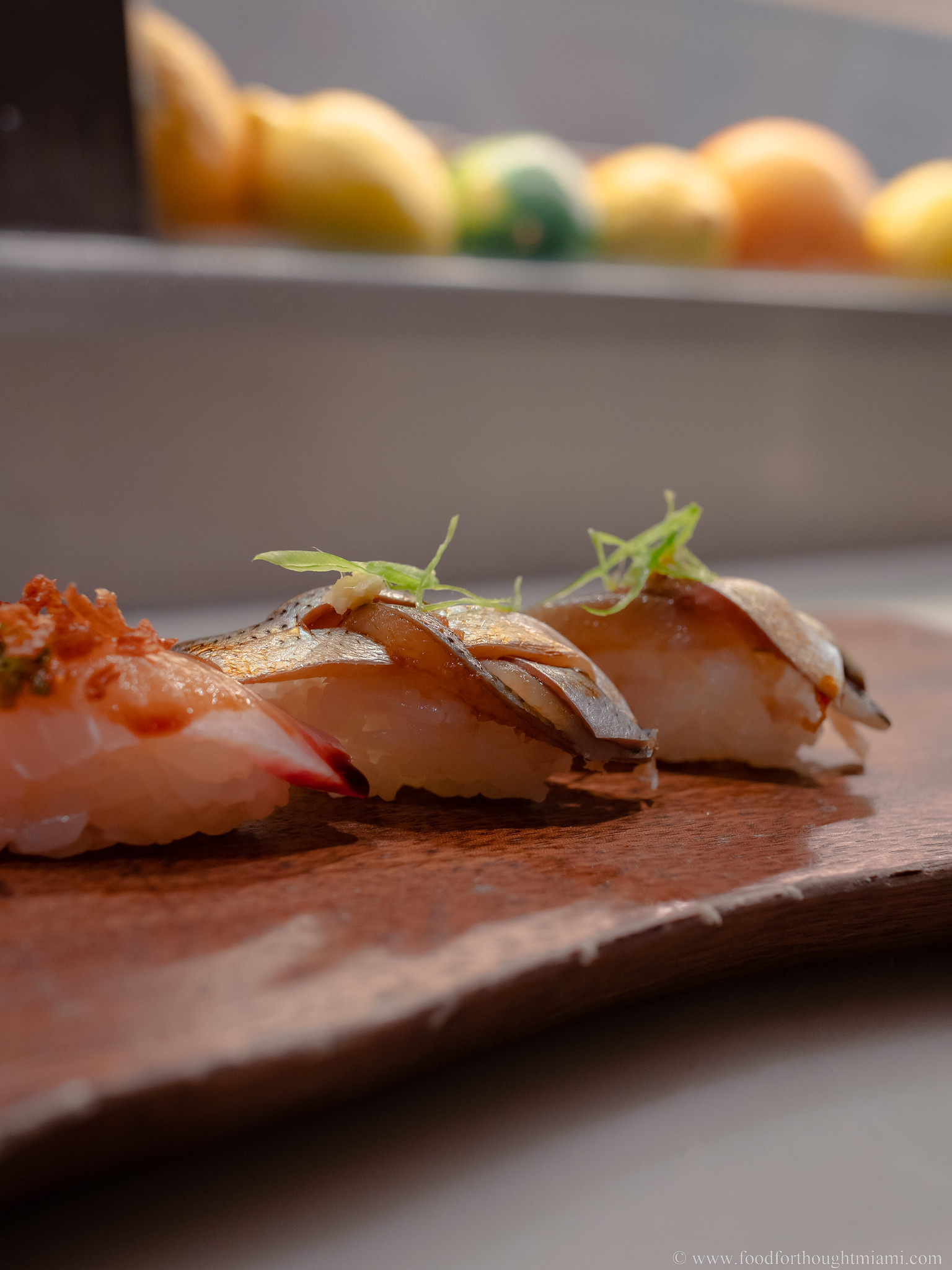
Uchi Miami has a whole section of their sushi menu devoted to "Toyosu Selections" which can run over a dozen deep, on top of a roughly equal number of selections from the regular menu. At the sushi bar they use a judicious but creative hand in how those selections are treated, with garnishes that complement rather than overwhelm. On a June visit we ordered almost exclusively from that list, and enjoyed everything, but especially this kohada (gizzard shad), one of my favorite neta, which was given a delicate vinegar cure, sliced and twisted into an elegant braid, and topped with a daub of minced ginger and slivered scallion.

(More pics from Uchi Miami | Wynwood).

Matrimonio - Porto (Chicago)

Tomato & Escabeche - Porto (Chicago)

More shiny little fish! I was intrigued by Porto when we booked a reservation during a short visit to Chicago; and I was truly wowed by the whole experience, which far exceeded my expectations. The restaurant is run by a group that has about a dozen venues under its wing, which makes its particularly focused and quirky vision all the more surprising: Porto is devoted to the flavors of Portugal and Spain's Galician coast, and more specifically to both the fresh and the high-quality preserved seafoods of that region, which exec chef Marcos Campos, CDC Erwin Mallet, and even pastry chef Shannah Primiano manage to work into just about every dish.

It is a gorgeous space, with a choreographed riot of colors and patterns on nearly every surface from floors to walls to ceiling. The main dining room is dominated by a long, three-sided "chef's island," while a second dining room in back has an almost outdoor feel, anchored by a huge, active cooking hearth. The tasting menu brings about a dozen rounds: marinated mussels crowning crispy potato cubes (served on a platter fashioned from a dehydrated flatfish carcass); a duo of oysters, both cold-smoked with a sea bean escabeche, and also poached in seaweed broth, then bathed in a cava emulsion; La Brújula sea urchin conserva atop toasted brioche along with smoked cauliflower purée and creamy Sao Jorge cheese. One of my favorites bites: this "matrimonio," a spin on a traditional tapa typically featuring white and dark anchovies, here done with house-pickled white anchovies and cured brown anchovies, served atop a delicate garbanzo bean cracker laced with stripes of red piquillo pepper and green dill and garlic purées.[2] And another, this brain-teaser of a dessert of pastry chef Primiano, with tomato panna cotta, a San Simon cheese shortbread, sweet pimentón, plankton olive oil, plum and apricot jam, and a strawberry and mussel sorbet, all nestled into a crab carapace. I'm a big fan of savory desserts, and this is just about as far as I've seen that envelope pushed, in an incredibly successful way.

This was a sensational meal, and the most surprisingly great experience of the year for us.[3]

(More pics from Porto | Chicago).

Salt Roasted Beets - Lion and the Rambler (Coral Gables)
Salt Roasted Beets - Lion & the Rambler (Coral Gables)

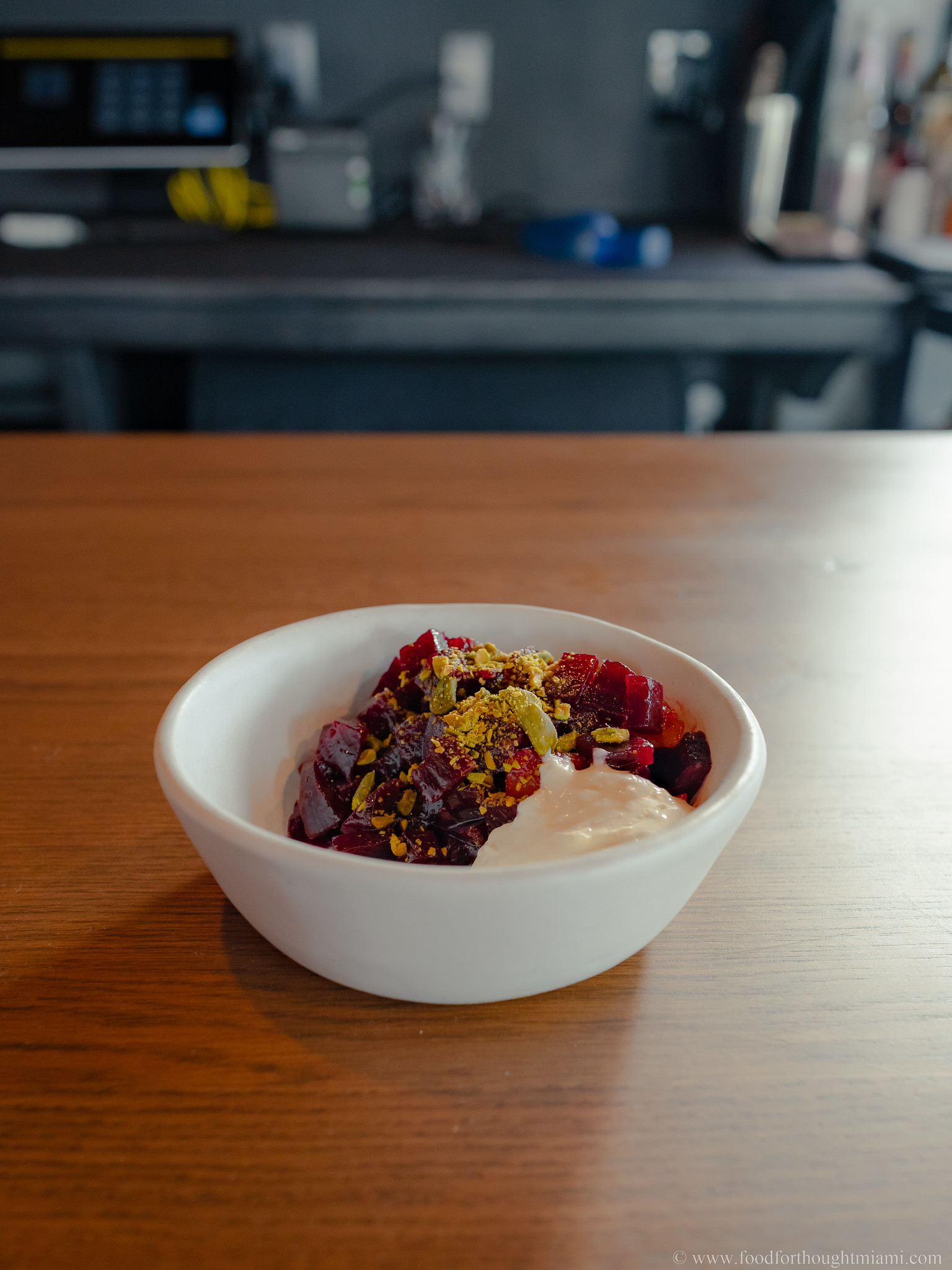
I remember ten years ago seeing an intriguing preview menu for a spot that was opening as a pop-up in a little café space on the northern edge of Coral Gables. The spot was Giorgio Rapicavoli's Eating House, which after a lengthy run left its original home, and recently reopened in a new location on Giralda Avenue. Meanwhile, a new spot with a peculiar name and an intriguing preview menu showed up in that original location. The spot is Michael Bolen's Lion & the Rambler, where we had a really promising first visit earlier this year. The food lineup actually reminds me quite a bit of EH's early days – creative, flavorful, fun, and adventurous, but not so far out there as to alienate anyone.[4] The house-baked breads (usually two choices are offered) were a highlight, and vegetables get their due, including on our visit maitake mushrooms drowning in a pool of neon-green parsley sabayon, and grilled broccolini under a blanket of mimolette fondue with nubbins of pickled kohlrabi. I was especially fond of these salt roasted beets, cubed and paired with ripe black velvet apricots,[5] crumbled pistachios and a frothy mousse of horseradish-spiked goat cheese.[6] Yeah, beets and goat cheese. It still works.


Chopped Aji Nigiri - Mr. Omakase
Chopped Aji Nigiri - Mr. Omakase (Miami)

To continue a theme here: way back in 2015, I was bemoaning the absence of good omakase options in Miami, while describing my first visit to Myumi, a food truck that set up shop in a vacant lot in Wynwood. Myumi offered a 12-course, $60 omakase served by chef Ryo Kato,[7] which you would eat piece by piece perched on a stool at a counter running along the truck's open side window. It was surprisingly good, and by the following year, the nigiri of chopped aji (horse mackerel) Chef Kato served at Myumi was one my favorite dishes of 2016.

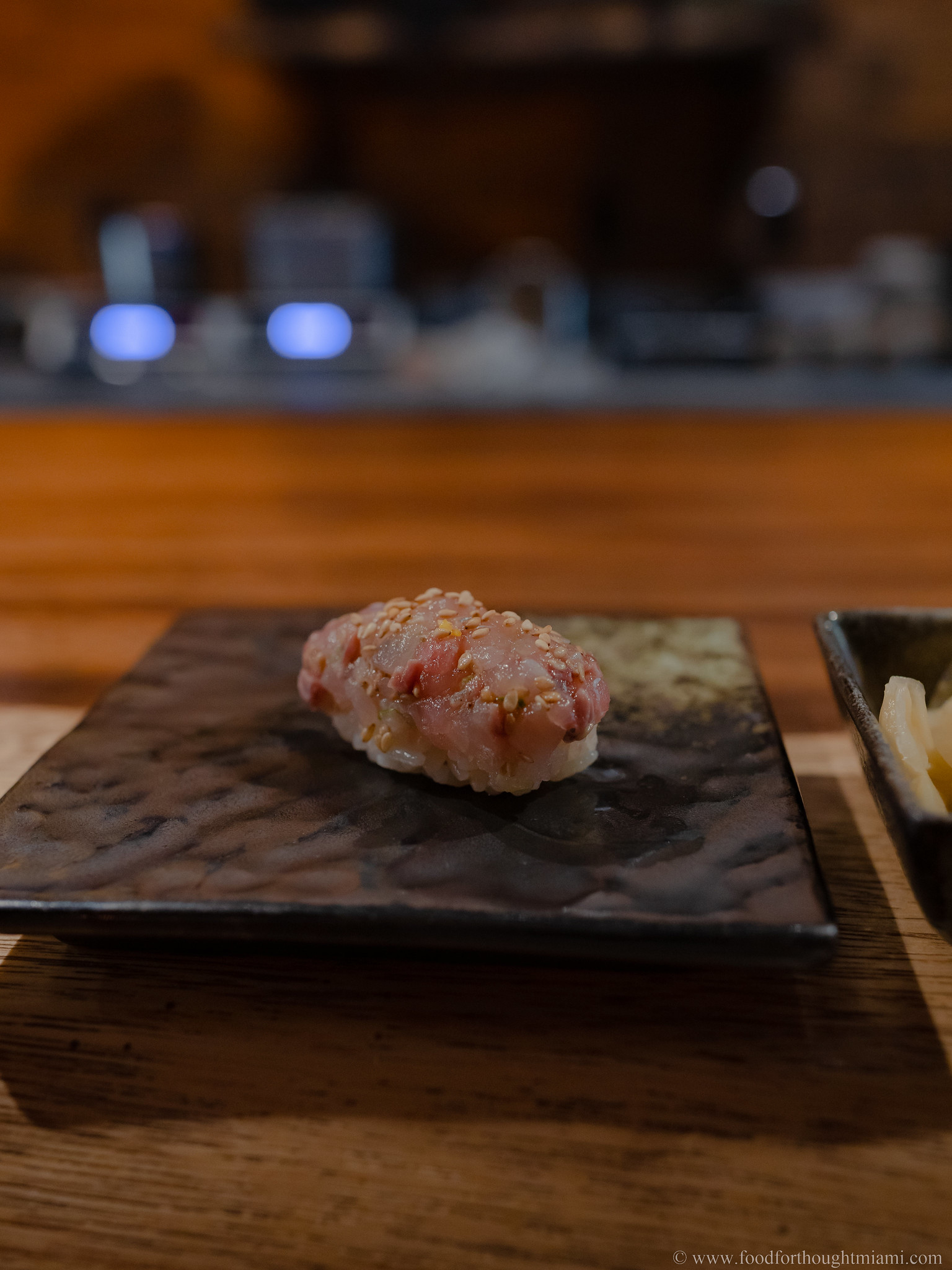
Flash forward to 2022, and Ryo is now running Mr. Omakase, a sushi counter downtown which offers three different "experiences" ranging from $89 - $149 for between 10 and 18 courses. We went with "the works," and given the going rates these days, it is also one of the better omakase price-to-value ratios available in the Miami market. My favorite bite? That same nigiri of aji chopped with ginger and scallion to a fine tartare, and topped with toasted sesame seeds.

(continued ...)